Agent Readiness: How to Measure More Than an AI Mention
A transparent proposal for agent-readiness testing: task definitions, repeated runs, evidence, safe handoffs and business outcomes—without inventing a universal score.
Suppose an assistant mentions your store, cites the right product page, selects the wrong pack size and stops at checkout. Did the store become more visible? Possibly. Was it ready for the customer's task? Not in the way the customer needed.
Agent Readiness is our working name for evaluating whether a business can be discovered, correctly understood and used within an authorised task. It is a proposed framework, not a shipped GEO Tracker AI score, a certification or an official OpenAI metric.
The distinction matters after the launch of GPT-6.1 Sol and Dots. More capable tools and persistent work create more opportunities for helpful action—but also more ways for an apparently successful answer to hide an incorrect outcome. We need evidence that follows the journey, not only the final paragraph.
- Keep answer visibility, factual accuracy, task outcomes and revenue separate.
- Define success and the allowed stopping point before the test.
- Repeat selected tasks to expose variation, but do not manufacture statistical certainty from a small pilot.
- Compare like with like. A model or tool change can break the meaning of a before/after comparison.
- Publish an evidence profile before considering a composite score.
Methodology & sources
Editorial review for factual claims (as of 2026-09-30).
This article proposes a pilot protocol; it does not report a completed agent study. Example counts are explicitly hypothetical. The methodology draws on our existing distinction between AI answer signals and business outcomes, plus OpenAI's guidance to bound and verify computer-use runs. No live purchase, customer-data transfer or production agent benchmark was performed for this article.
Why a new name must come with a clear boundary
We already need to distinguish a mention, a recommendation and a citation. An agent adds actions: opening a page, selecting a variant, preparing a comparison or attempting a permitted handoff. These are not interchangeable observations.
“The agent found us” should mean the business entered the observed candidate set, with a record of how it was found. “The agent understood us” needs factual checks against current sources. “The agent completed the task” needs the expected final state, not just a claim of completion in its answer.
Even a verified task outcome does not prove commercial impact. The buyer may reject the shortlist or buy elsewhere. A prepared cart is not an order, and an enquiry is not qualified revenue. Our citation-impact guide explains the same boundary for answer exposure.
The point of the framework is to assign a useful fix to the correct failure—not to collapse these different events into an impressive number.
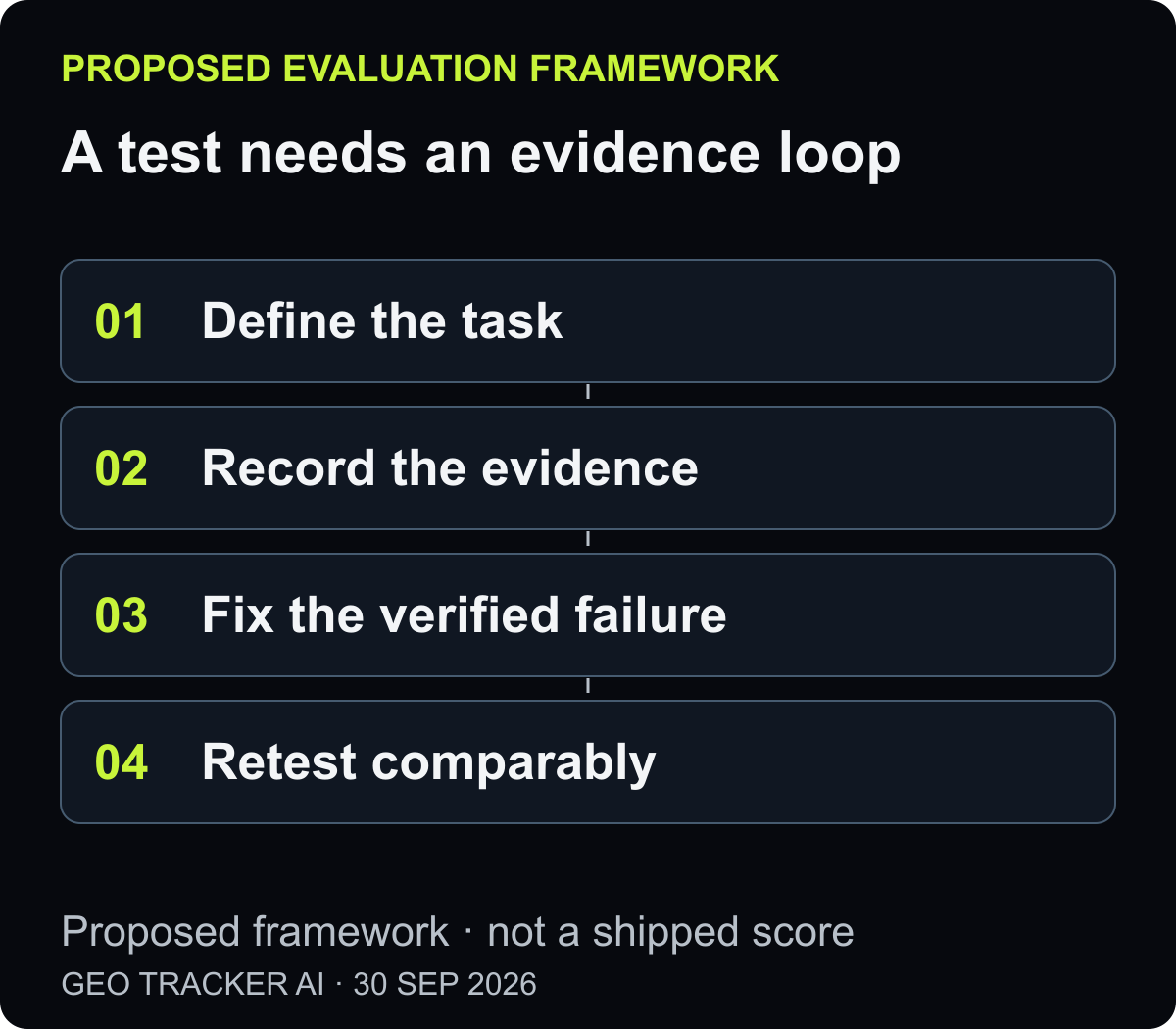
Step 1: Build a task panel, not a brand-prompt collection
Start with the jobs customers actually ask a system to do. Include unbranded discovery, comparison with constraints, verification of a specific offer and a safe next step. Do not make every task name your business; that would measure prompted recognition rather than independent discovery.
For each task, specify the buyer's market and language, product or service requirements, information needed, access conditions and expected stopping point. Include one deliberately unsuitable scenario. A trustworthy agent should reject an offer that fails the constraints.
Example: “Find three software options for five support staff, with this integration and monthly billing. Explain exclusions and prepare links for a human review. Do not register accounts.” Success is an evidence-backed shortlist. An agent opening a signup page is not required, and creating an account would violate the test boundary.
Keep the first pilot small enough to review every run. A panel of ten tasks may be practical for a team, but ten is a proposed operational size, not proof of market representativeness. Validate the questions with support, sales and customer research rather than treating an LLM-generated list as customer demand.
Step 2: Predefine observable outcomes
Use separate fields rather than an undefined “pass”. Our proposed minimum record contains:
| Observation | What qualifies | What does not qualify |
|---|---|---|
| Candidate inclusion | Business appears in the observed shortlist | A brand name hidden only in retrieved material |
| Factual correctness | Required facts match current authoritative evidence | Fluent language or plausible assumptions |
| Constraint fit | Eligibility and exclusions are applied correctly | Selecting an offer despite a required missing feature |
| Permitted completion | The predefined safe endpoint is verified | Claiming success without the final state |
| Appropriate handoff | Required approval or missing information is surfaced | Guessing, skipping approval or treating all pauses as errors |
Not every dimension applies to every task. A discovery task may not include a form. Mark that field not applicable, not zero. A platform outage may prevent observing the task; record not measured or an operational failure rather than interpreting it as poor brand performance.
To reduce grading drift, write examples of a correct and incorrect result before testing. If two reviewers disagree about what “fits” means, resolve the criterion before using it to compare vendors.
Step 3: Preserve the run conditions and evidence
Record the service and interface, model where disclosed, tools, date, language, country, session state, task version and permitted actions. An API call with selected tools is not automatically equivalent to a consumer ChatGPT interface or a Dot with connected apps and memory.
Existing memories and prior shopping context can change a shortlist. Use a declared fresh-session protocol where feasible, or label persistent context as part of the test. Do not claim independence simply because you submitted the same words again.
Retain the useful evidence: visited sources, extracted facts, observed UI state, error messages and the verified endpoint. Never publish private credentials, account contents or raw customer details in an article or dashboard. A public case study should contain a sanitised explanation, not a browsing transcript with personal data.
Set step, time and cost limits, and establish how the test stops. OpenAI's computer-use guidance emphasises bounded runs and outcome verification. That discipline is as important as the scoring rubric.
Step 4: Repeat without pretending a pilot is a population
One successful run can demonstrate possibility. It cannot establish reliability across users, tasks or time. Repeating selected tasks can expose alternate choices, overlooked constraints and intermittent failures.
There is no universal rule that three runs are enough for agent evaluation. Our weekly repeated-answer methodology addresses an existing monitoring workflow; it is not empirical proof of the ideal repetition count for all agent tasks. A pilot should choose its repetitions according to cost, risk and observed variation, then state the sample size.
Hypothetical example: ten tasks repeated three times produce 30 runs. If 18 reach the intended safe endpoint, the observed completion rate is 18/30, or 60%, for that panel and environment. It is not a 60% probability that all customers will buy from you. If three runs were blocked by a platform incident, report their status and denominators separately rather than quietly dropping them.
Do not mix task types into an unexplained average. A simple fact lookup and a constrained multi-page comparison are different workloads. Report counts by task family and explain what the sample covers.
Step 5: Diagnose before assigning blame
A failed outcome can have several causes. The website may contain inconsistent facts. The interface may hide an error. The agent may misread correct information. A tool can time out. An approval requirement can correctly stop the task.
Use a failure taxonomy that separates these cases: offer-data defect, interaction defect, agent interpretation error, access or platform failure, and correct safety handoff. Keep uncertain attribution explicit. “Cause not yet established” is more useful than an unjustified claim that your SEO is broken.
Reproduce the failure before writing the brief. A human check can establish whether the page actually omits a requirement. A second run can show whether the agent's error recurs. Neither automatically proves why a provider chose a competitor.
The deliverable is an actionable evidence card: failed task, source, business risk, likely cause with confidence, owner and acceptance test. That makes the measurement part of operational work rather than another chart to watch.
Step 6: Remeasure without erasing the release boundary
Keep the original task and conditions for a before/after check where possible. Log implemented changes and when they became visible. If the model, agent product, tools or access changed, show that context alongside the result.
After a provider release, consider a new baseline. Running the old and new environment against the same tasks can help distinguish a website fix from a platform shift, where access and cost allow. Without that comparison, describe the observed change but avoid a strong causal claim.
Commercial validation remains another track. Use first-party leads, orders and customer feedback to assess whether the fix helped the business. A bot-looking visit in logs does not by itself identify a buying agent or establish attribution.
Why we would not start with a single score
A composite score requires justified weights, coverage rules and treatment of unknowns. Giving five dimensions equal weight is a design choice, not a scientific finding. A site with perfect lookup facts and a broken handoff should not conceal that critical failure behind an average.
The first useful output is a profile: which tasks were tested, how many runs were usable, which facts were correct, where the journey stopped and which fixes are warranted. A score can be considered later if it makes decisions clearer and its definition survives independent review.
At GEO Tracker AI, this publication describes a roadmap direction and a pilot design—not a new enabled Dots measurement channel. Existing answer monitoring continues on its own terms. Any future agent product must demonstrate actual coverage, permissions, evidence quality and operational costs before we present it as shipped.
That is the standard businesses should demand from any “Agent Readiness” offering: show the task, the evidence, the limits and the next fix. The name alone proves nothing.
Frequently asked questions
The same Q&A pairs ship as FAQPage structured data so AI engines can quote them verbatim.
- Is Agent Readiness an official metric or certification?
- No. Here it is GEO Tracker AI's proposed framework for task-based evaluation. It is not an OpenAI standard, a certification or a newly enabled product score. The task panel, observed dimensions, evidence and limits must be defined before results can support a decision.
- Are three agent runs enough to prove reliability?
- There is no universal basis for that conclusion. Repetition can expose variation, but a small task panel does not represent all buyers or environments. Choose repetitions according to risk, cost and observed behaviour, and report the task counts, run conditions and unknown outcomes.
- How should unavailable or blocked runs be counted?
- Keep their status and reason visible. Not applicable, not measured, platform failure and correct safety handoff are different cases. Report the denominator for each observed metric and do not silently drop incidents or score missing evidence as a confirmed failure of the business.
- Can task completion prove that GEO increased sales?
- No. A verified shortlist, prepared cart or successful enquiry is a task outcome, not a sale or causal attribution. Assess qualified leads, orders and customer feedback separately in first-party records. Model, tool and website changes also need context before drawing before-and-after conclusions.
Methodology sources and related reading
- OpenAI: Computer use — bounded, isolated runs and independent outcome checks.
- OpenAI: Dots safety — access, action checks and remaining limitations.
- Our repeated-answer methodology — current answer-monitoring rationale, not a general agent benchmark.
- Our product-recommendation audit interpretation — why interface and repetition matter.
Reviewed September 30, 2026. The task panel, dimensions and example figures here are a proposed framework, not measured results.
Related articles
Your GEO Score
Establish an AI mention baseline you can defend
GEO Tracker AI runs repeatable checks for supported engines so you can see whether your brand is mentioned, what context shows up, and how that changes week over week — complementary to Search Console, not a replacement for it.