An Agent-Ready Website: A Practical Playbook for Ecommerce and SaaS
Can an AI agent understand, compare and use your offer? A practical website audit for product facts, SaaS pricing, service eligibility and safe customer handoffs.
An agent-ready website is a website from which a permitted AI assistant can obtain accurate offer information, evaluate the customer's requirements and reach a dependable next step. It is not a website that tells the agent what to think.
OpenAI's Dots launch makes this question timely. But you do not need a Dots integration—or proof that agent shopping is already mainstream—to benefit from fixing a contradictory price or an unusable enquiry form. The same defects create friction for people.
This playbook moves from “we should optimise for agents” to a bounded worklist. Its examples are hypothetical, not client results or claims about what Dots will choose.
- Audit one real buyer journey before changing the whole site.
- Prioritise missing decision facts and broken next steps over special AI files.
- A retailer, SaaS vendor and service business need different evidence of fit.
- Support safe approval and human handoff. Do not remove safeguards to make an agent complete more tasks.
Methodology & sources
Editorial review for factual claims (as of 2026-09-30).
This is an editorial checklist informed by OpenAI's computer-use safety guidance, Google product-data guidance and normal buyer requirements. It is not an official certification, a measured agent ranking factor or a production Dots audit. Examples do not authorise purchases, data disclosure or account changes.
Start with the customer's constraint
“Can an agent read our homepage?” is too easy a test. It might read the page perfectly and still fail the actual buying decision. Start with a requirement that can disqualify the offer.
For a retailer: “Find a compatible replacement part under $80 delivered to my ZIP code by Friday. Prepare options; do not buy.” For SaaS: “Compare customer-support tools for five people with this CRM integration, using month-to-month pricing.” For a service business: “Find a provider that serves this city, can handle this job size and will explain what happens after an enquiry.”
Each task needs an expected outcome before you run it. That can be a qualified shortlist, an accurate comparison or a draft enquiry. A purchase is not necessary to establish that product identification or price interpretation works.
Define the information boundary too. Use synthetic test details, not a customer's private records. If a contact form would send a real message, stop before submission or use an explicitly approved test destination.
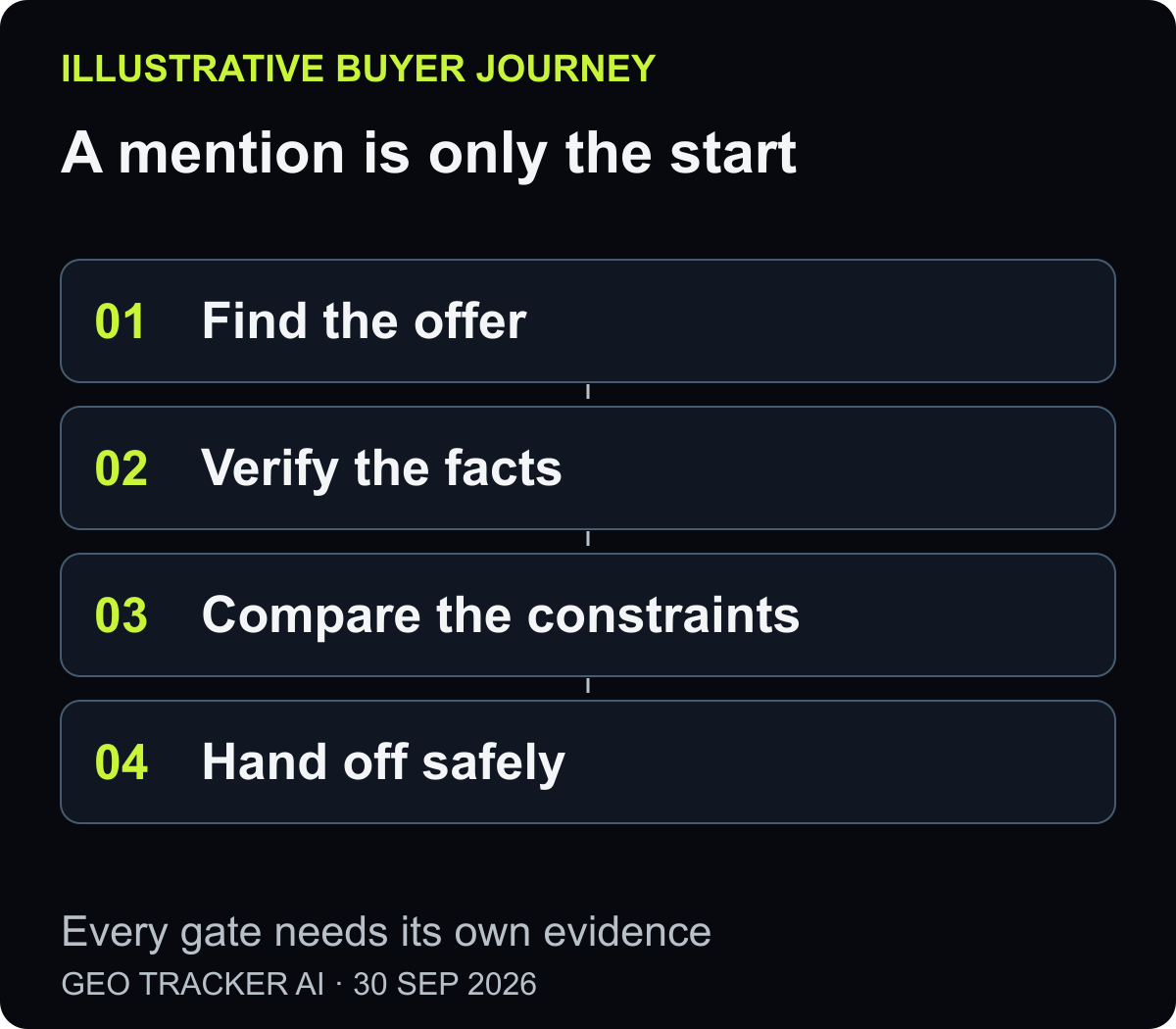
Gate 1: Can the offer be found and identified?
Inspect the route to the actual offer, not just the domain. A product variant should have a stable destination. A SaaS feature should explain which product and tier it belongs to. A local service should name the relevant area and scope rather than implying nationwide coverage from a generic footer.
Check internal links, meaningful headings, crawl access and unexpected redirects. A valid public URL that lands on an unavailable product or the wrong language is not a successful discovery outcome. Public documentation should be reachable without an account unless there is a genuine reason to protect it.
Do not open private information to crawlers in the name of GEO. Separate public decision evidence from account data. Search access, browser access and authorised API access are different paths, with different security requirements.
Useful acceptance check: an unfamiliar person can locate the exact offer and say who provides it, what it is and who it is for. An assistant should be tested against the same facts, not granted a lower bar because it returned fluent text.
Gate 2: Can the facts be verified?
For ecommerce, compare the visible page, applicable structured data, feed and cart. Google's Product documentation explains how markup and Merchant Center data relate. The decision problem is consistency: identity, variant, price, currency, availability and conditions must refer to the same purchasable item.
For a US retailer, distinguish the item price from the destination-dependent total. Do not present a tax-exclusive price as a universal final amount. Shipping eligibility, recurring subscriptions and return exclusions can change the decision. The right answer may be “the total requires a destination”, not a guessed number.
For SaaS, publish what the price actually buys: billing interval, minimum seats, included usage, overage basis, plan-specific integrations and any prerequisites. “From $20” is insufficient for an agent evaluating five seats with a feature that starts on another plan. State what happens when the usage limit is reached.
For services, explain scope, location, prerequisites, typical next steps and the limits of estimates. If a quote requires a site visit, say so. A useful public page can be specific without promising a price for work it has not inspected.
| Business | Often missing | Evidence that resolves it |
|---|---|---|
| Ecommerce | Exact variant and destination-dependent cost | Variant page plus delivery rules and cart check |
| SaaS | Effective cost for the required feature | Plan-feature matrix with billing and usage assumptions |
| Services | Eligibility and scope of a quote | Service-area and process page with exclusions |
Give each important fact an owner and update path. Adding a timestamp to a stale page does not make its price current. Synchronisation matters more than the appearance of freshness.
Gate 3: Can the agent make a fair comparison?
Your homepage can describe benefits while leaving the buyer's objections unanswered. Create decision evidence where the offer lives: compatibility limitations on the product page, plan availability near the feature, exclusions next to the service promise.
Suppose an agent compares three tools. One vendor's “unlimited” offer has a fair-use boundary buried elsewhere; another clearly states included usage and overage. Clearer evidence makes the second offer easier to evaluate. It does not prove the agent will recommend it, but it removes an avoidable ambiguity.
Avoid anonymous “best” claims and unsupported competitor numbers. A comparison should tell the reader when your offer is a poor fit. That is commercially useful: a company needing an unavailable integration is not a qualified lead, however prominent your brand is in the answer.
Use a simple source hierarchy when reviewing results: current product or service terms for offer facts, documented support policies for exceptions, and independent evidence where relevant. A copied price in an old blog post should not overrule the current plan page.
Gate 4: Can the next step be completed safely?
An assistant might use rendered screens, browser controls or exposed tools. There is no single universal agent-reading mode. Test the interfaces you actually intend to support. Clear labels, native controls, keyboard access and explicit validation errors help make the journey observable.
Check variant selection, price recalculation, checkout summaries, demo scheduling and enquiry confirmation. Separate a button click from a successful result. A thank-you screen does not establish that a booking exists unless the receiving system confirms it.
OpenAI's computer-use guidance recommends isolated environments, bounded runs and controls for consequential actions. Your business should preserve those boundaries too. An agent should be able to prepare a cart or enquiry without accidentally making a commitment.
For Dots specifically, the safety documentation says purchases require approval. An approval pause can be the correct endpoint of the test. Security challenges should be assessed for false positives through legitimate test arrangements—not bypassed, disabled wholesale or treated as permission to access a protected account.
Do you need MCP, a feed or llms.txt?
Maybe, for a defined use case. None is a universal prerequisite for a useful public website.
An authorised API or MCP tool may help retrieve structured facts or complete a specific action. It needs authentication where appropriate, clear ownership and bounded write permissions. Publishing an endpoint is not evidence that Dots or another assistant will discover and use it.
A product feed is a separate distribution path with provider-specific onboarding. Our product-data readiness guide explains why feed approval is not an AI recommendation.
An optional llms.txt can point supported consumers to documentation. It should not become the only place where important facts exist. Nor should schema contain terms missing from the visible page. The durable source is the actual offer and its usable documentation.
Build a small worklist with a real owner
Take five representative journeys: one common buyer, one price-sensitive buyer, one constrained by compatibility, one excluded by your terms and one needing human help. Five is a suggested pilot scope, not a statistically representative market sample.
Run the public-information checks first. Then test available assistants under recorded conditions. Group problems by business impact: wrong purchasable item or price is critical; a missing condition can change fit; poor wording may merely slow the journey.
Every brief should contain the failed step, source evidence, expected fact or state, responsible team, implementation URL and a repeatable acceptance check. Marketing owns explanations; merchandising owns product truth; engineering owns interactions; sales or support validates what is actually promised.
After implementation, rerun the same tasks without silently changing the customer's requirements. Inspect the new evidence, not only the assistant's summary. An improved workflow is a useful result even before you can establish any effect on traffic or revenue.
What GEO Tracker AI can contribute
Observed AI answers can identify where a brand is absent, incorrectly described or poorly supported. That creates a sensible entry point for an agent-readiness pilot. It does not mean our current free Snapshot already executes these buyer journeys.
Our proposed measurement framework keeps answer visibility, task completion and commercial outcomes separate. The goal is not to replace SEO with another opaque score. It is to make the next fix defensible: what failed, why it matters and how we will know it works.
Frequently asked questions
The same Q&A pairs ship as FAQPage structured data so AI engines can quote them verbatim.
- What makes a website agent-ready?
- A permitted assistant can find the relevant offer, verify accurate facts, apply buyer constraints and reach a dependable safe next step. This requires clear public evidence and usable interfaces, not instructions telling the agent to recommend the business. No checklist guarantees selection or a purchase.
- Do I need an MCP server to be found by agents?
- Not universally. An authorised integration may help with a defined task, but a published endpoint does not prove an assistant will discover or use it. Start with accurate public offer information and a usable buyer journey; add an integration only when its access and purpose are clear.
- What should a retailer or SaaS company fix first?
- Fix contradictions that can change the buying decision. Retailers should inspect identity, variant, availability and destination-dependent costs. SaaS companies should clarify billing, seats, usage and plan-specific features. Then verify the correct product, demo or contact handoff, with an owner and an acceptance check.
- Should an agent test complete a real purchase?
- Usually not for an initial audit. Define a safe endpoint such as a supported shortlist or prepared cart, use synthetic details, and do not transmit data or commit a transaction without authorisation. A required approval pause can be the correct outcome rather than a failure.
Primary guidance and scope
- OpenAI: Computer use — environment, outcome verification and permission controls.
- OpenAI: Dots safety — approval and action boundaries.
- Google: Product structured data — product markup and merchant data.
Checked September 30, 2026. The checklist and examples are our editorial synthesis, not an official ranking formula or demonstrated merchant uplift.
Related articles
Your GEO Score
Establish an AI mention baseline you can defend
GEO Tracker AI runs repeatable checks for supported engines so you can see whether your brand is mentioned, what context shows up, and how that changes week over week — complementary to Search Console, not a replacement for it.