ChatGPT vs Perplexity: Citations, Retrieval, and What to Optimize For
These products answer questions differently. Here is a vendor-grounded comparison plus a practical checklist — with clear separation between facts, documentation, and practitioner heuristics.
If you are building a GEO practice, “optimize for AI” is too vague. ChatGPT and Perplexity are different products with different default behaviors, different citation UX, and different implications for what you publish on the open web.
This article separates vendor-documented behavior from team observations, and ends with a checklist you can execute without buying into hype.
Methodology & sources
Editorial review for factual claims (as of 2026-04-11).
- Vendor documentation is cited for OpenAI crawler roles and Perplexity crawler roles.
- Practitioner heuristics (freshness, structure, corroboration) are labeled as heuristics — not deterministic ranking rules published by vendors.
- Conversion numbers are not treated as universal benchmarks; if you measure referrals, do it in your own analytics with transparent UTMs.
Product-grounded facts
- ChatGPT combines training-time priors with product-specific retrieval depending on surface/settings; OpenAI publishes separate crawler policies for search inclusion vs training collection vs user-initiated fetching.
- Perplexity documents
PerplexityBot(indexing/surfacing) separately fromPerplexity-User(user-initiated access), and states user-initiated fetch generally ignoresrobots.txt.
Heuristic (not a guarantee)
- Publishers often report that fresh, structured pages are easier to cite in retrieval-heavy experiences — but outcomes vary by query, competition, and language.
ChatGPT: training knowledge vs documented crawler roles
Why “two modes” matters for brands
ChatGPT-family assistants can answer from patterns learned during training and/or from information retrieved after training, depending on what the product is doing for a given request. Product behavior changes over time — verify specifics in-product for your audience.
What OpenAI states publicly (policy-relevant)
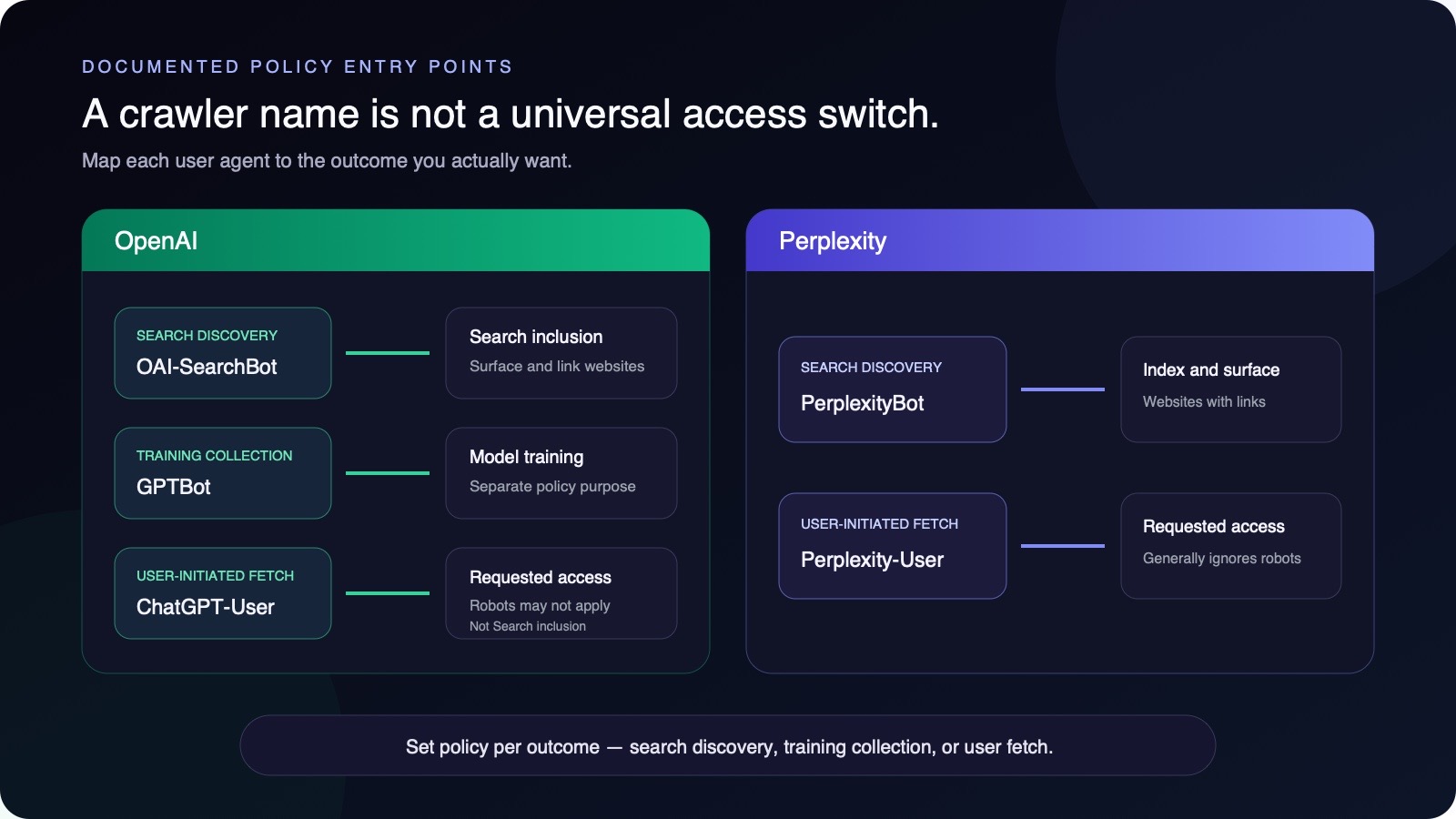
OpenAI documents distinct user agents, including:
OAI-SearchBot: used to surface websites in ChatGPT search features; opted-out sites are not shown in those answers (per OpenAI’s description).GPTBot: used for training-data collection workflows for foundation models (separate policy intent from search inclusion).ChatGPT-User: user-initiated page access; OpenAI states robots rules may not apply to these user actions, and that Search inclusion should be managed viaOAI-SearchBot.
Source: OpenAI — Overview of OpenAI Crawlers: developers.openai.com/api/docs/bots
“Source hierarchy”: keep claims defensible
It is tempting to claim a rigid global hierarchy (“Wikipedia always wins”). Vendors do not publish that as a deterministic ruleset.
A more defensible framing:
- Corroboration wins: independent pages that agree on facts reduce ambiguity.
- High-trust references matter for some entities: encyclopedic pages and major directories can matter when they are consistently treated as authoritative for a topic — in many cases, not universally.
- Your own site still matters: pricing, product boundaries, integrations, and docs are best authored by you — and kept consistent everywhere else.
If you are tempted to “optimize Wikipedia”: conflict-of-interest editing is a reputational risk; prioritize independent, reliable coverage and accurate listings rather than gaming.
Perplexity: indexing vs user-initiated access
What Perplexity states publicly
Perplexity’s crawler documentation states that PerplexityBot is used to surface and link websites in Perplexity search results and is not described there as crawling for foundation model training. Separately, Perplexity-User is described in relation to user-initiated page access.
Perplexity also states that because user-initiated fetch is user-requested, that fetcher generally ignores robots.txt rules.
Source: Perplexity — Perplexity crawlers: docs.perplexity.ai/guides/bots
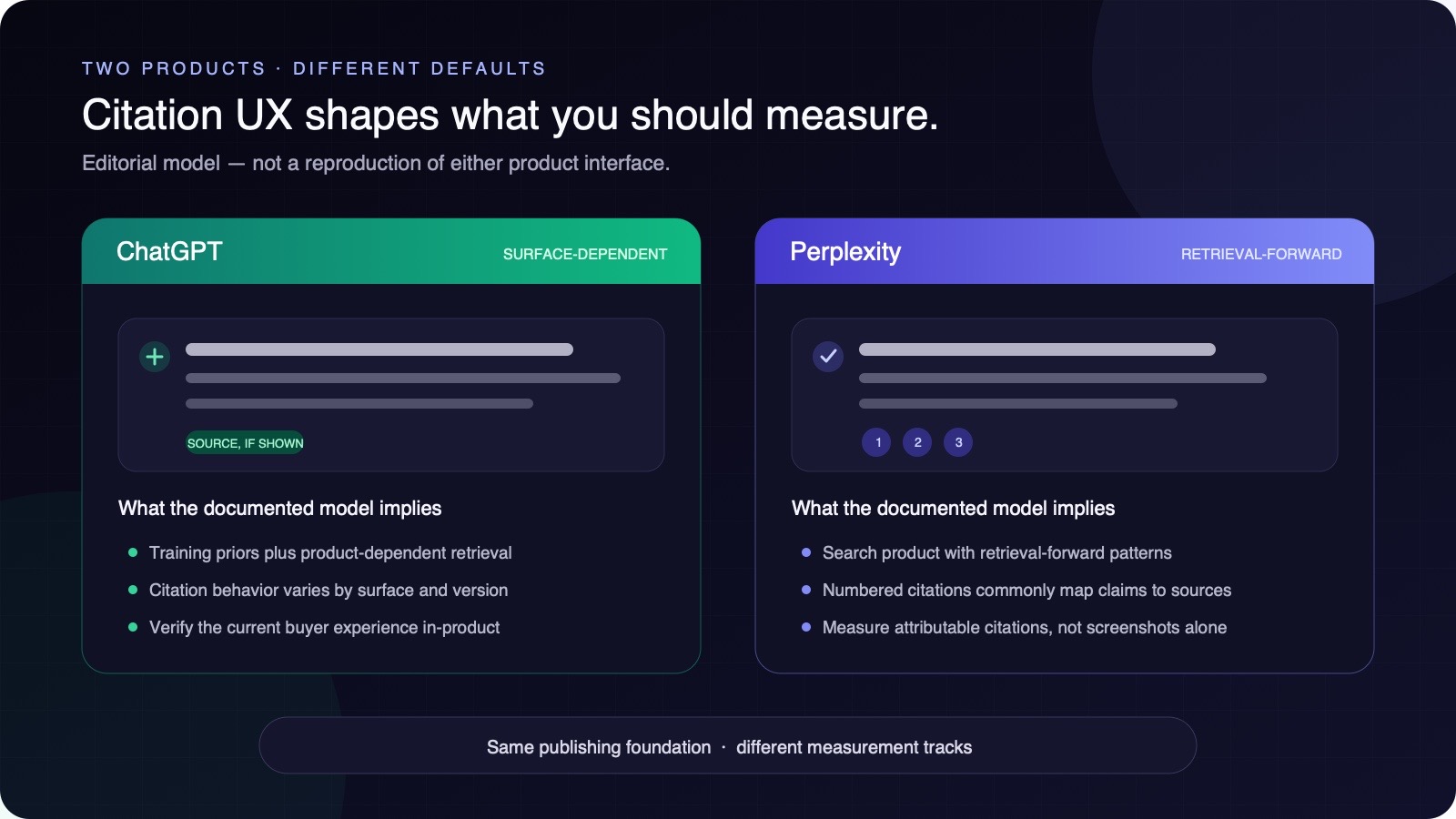
Inline citations as a product feature
Perplexity’s UX commonly presents numbered citations tied to sources. That matters for publishing strategy because clearly attributable sentences are easier for readers (and systems) to map to a specific page.
Conversion rate folklore (why we avoid it here)
You may see viral statistics comparing conversion rates across channels. Unless you can cite a primary methodology you trust — and the study matches your industry and locale — do not treat those numbers as facts in your operating model.
If you want a documented starting point for how to think about measurement, Seer Interactive published a transparent GA4 case study analyzing referral conversion differences across channels for a specific site and window — useful as methodology inspiration, not a universal benchmark.
Source: Seer Interactive — Case study: how traffic from ChatGPT converts: seerinteractive.com/insights/case-study-6-learnings-about-how-traffic-from-chatgpt-converts
Side-by-side comparison (careful language)
| Dimension | ChatGPT (family product) | Perplexity (search product) |
|---|---|---|
| Knowledge + retrieval | Training priors + product-dependent retrieval; verify current surfaces | Retrieval-forward product patterns with citations in many flows |
| Citation UX | Varies by surface/version | Often uses inline citations tied to sources |
| Crawl policy entry points (documented) | OAI-SearchBot / GPTBot / ChatGPT-User (distinct roles) | PerplexityBot / Perplexity-User (distinct roles; user fetch ignores robots per docs) |
| What to optimize first | Clear entity + canonical facts + deliberate bot policy choices | Freshness + extractable answers + fast, stable pages |
What this means for your GEO program
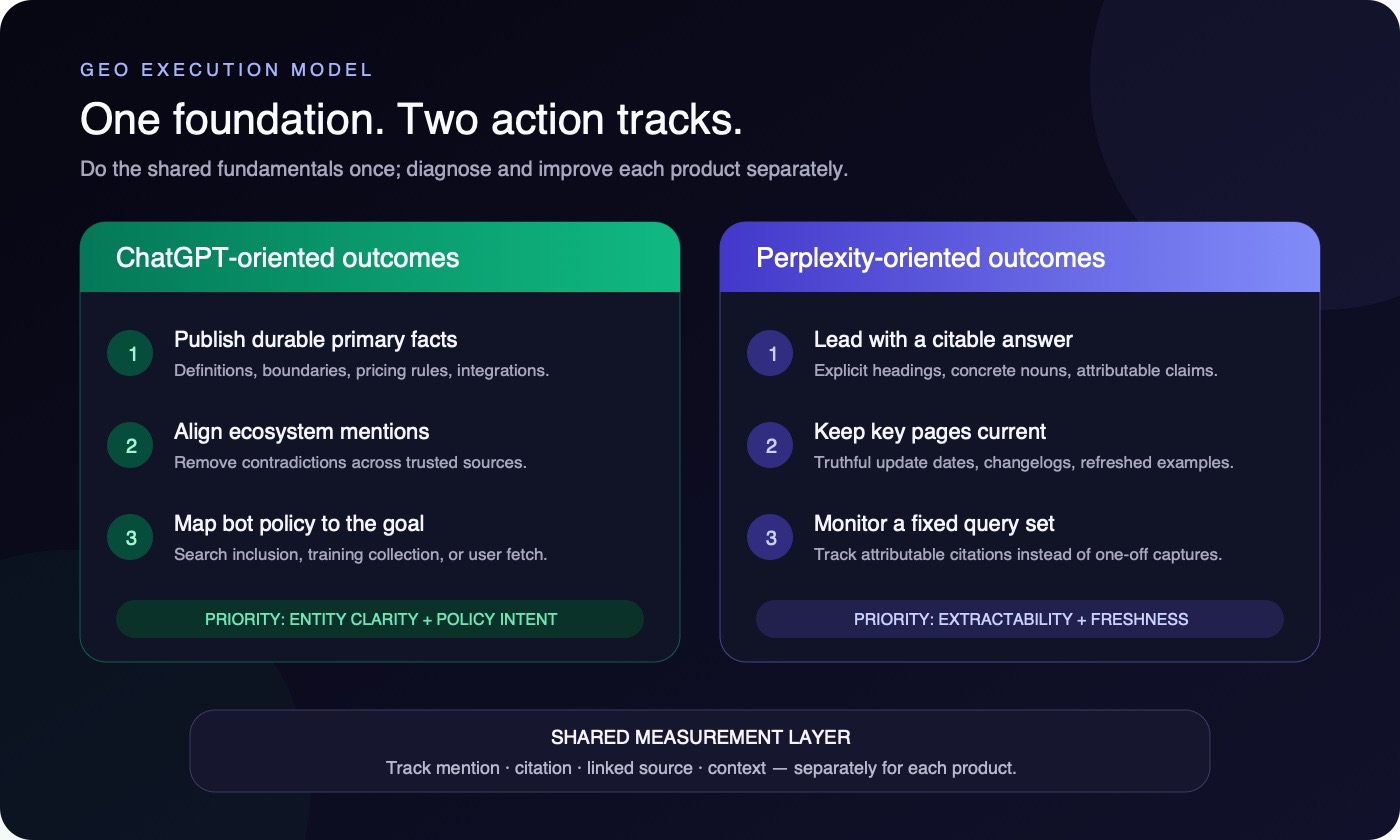
For ChatGPT-oriented outcomes
- Publish durable primary sources on your domain (definitions, limits, pricing rules, integrations).
- Align ecosystem mentions so third parties do not contradict your canonical claims.
- Map robots decisions to outcomes: search inclusion vs training collection vs user-initiated fetch (do not treat
GPTBotas a stand-in for everything).
For Perplexity-oriented outcomes
- Make pages easy to cite: answer-first structure, explicit headings, concrete nouns.
- Keep key pages current: truthful “last updated” signals, changelogs, refreshed examples.
- Monitor citations for a fixed query set rather than chasing one-off screenshots.
Track separately (because the failure modes differ)
A brand can be strong in one surface and weak in another. Split your reporting minimally:
- Prompt list A: buyer questions where ChatGPT is strategically important
- Prompt list B: research questions where Perplexity is strategically important
Soft utility: copy the prompt list pattern from What Is GEO? and score answers weekly in a spreadsheet before you automate.
For how Google frames AI-mediated surfaces inside Search (and why third-party “AI Overview CTR” headlines are easy to misread without methodology context), read Google AI Overviews vs AI Mode. For a practical comparison of SEO vs GEO resourcing and success signals, read GEO vs SEO in 2026.
Practical checklist
ChatGPT
- Confirm what your buyers actually ask in ChatGPT-style phrasing (customer interviews + support logs).
- Ensure your domain’s canonical facts are easy to find without logging in.
- Audit documented crawler roles (
OAI-SearchBot,GPTBot,ChatGPT-User) against your policy goals.
Perplexity
- Audit documented crawler roles (
PerplexityBot,Perplexity-User) and understand robots limitations for user-initiated fetch. - Add structured Q/A where truthful (FAQ sections) and keep answers tight.
- Improve performance on key URLs (slow pages fail users even when citations exist).
Closing
ChatGPT and Perplexity are not interchangeable, but the publishing strategy rhymes: be specific, be consistent, be corroborated, and measure with discipline.
Sources and official documentation
- OpenAI — Overview of OpenAI Crawlers: developers.openai.com/api/docs/bots
- Perplexity — Perplexity crawlers: docs.perplexity.ai/guides/bots
- Google Search Central — AI features and your website (context on AI-mediated answers in Search): developers.google.com/search/docs/appearance/ai-features
- Seer Interactive — GA4 case study (single-site; methodology): seerinteractive.com/insights/case-study-6-learnings-about-how-traffic-from-chatgpt-converts
Frequently asked questions
The same Q&A pairs ship as FAQPage structured data so AI engines can quote them verbatim.
- Does ChatGPT cite sources?
- ChatGPT cites sources when it's in search mode (`OAI-SearchBot` retrieval) — inline links appear underneath the answer. In closed-book mode (no live retrieval), it summarises from training knowledge without citations. Brands need to optimise for both modes because the user usually can't tell which one fired.
- Why does Perplexity cite more than ChatGPT?
- Perplexity's product model is citation-first: every answer must be backed by retrieved URLs from Sonar (typically 10 fetched, 3-4 cited inline). ChatGPT only retrieves when it judges the query needs fresh information. Same query, different retrieval policy, different citation density.
- Do GPTBot and OAI-SearchBot do the same thing?
- No. GPTBot is OpenAI's training crawler — what it fetches becomes part of future model knowledge. OAI-SearchBot is the live-search crawler — what it fetches feeds ChatGPT's search-mode answers and is what powers citations. Blocking GPTBot alone does not stop ChatGPT from citing you.
- Should I allow PerplexityBot?
- If you want to be cited inside Perplexity answers — yes. PerplexityBot is the indexer that feeds Sonar retrieval; Perplexity-User is the on-demand fetcher when a user explicitly visits your URL. Blocking either removes you from Perplexity citations for the queries that touch your category.
Related articles
Your GEO Score
Establish an AI mention baseline you can defend
GEO Tracker AI runs repeatable checks for supported engines so you can see whether your brand is mentioned, what context shows up, and how that changes week over week — complementary to Search Console, not a replacement for it.