GEO vs SEO in 2026: A Practical Comparison (Without the Hype)
SEO and GEO solve different discovery problems. Here is a defensible way to compare them, allocate effort, and measure progress — with third-party context clearly labeled.
You will still see hot takes claiming “SEO is dead.” In practice, most brands need both classic web search visibility and visibility inside AI-generated answers — but the mechanics, success signals, and measurement differ enough that treating them as identical workstreams creates blind spots.
Short definition: SEO optimizes pages to earn visibility in ranked search results. GEO (Generative Engine Optimization) optimizes how your brand is represented, retrieved, summarized, and cited when people use AI-assisted interfaces (for example AI summaries in Search, conversational assistants, or AI-native search products).
This guide compares the two on dimensions that matter for planning: what “success” means, what overlaps in execution, where strategies diverge, and how to measure responsibly.
Methodology & sources
Editorial review for factual claims (as of 2026-04-11).
- Official platform guidance is cited verbatim where we summarize Google’s public statements on AI features in Search.
- Third-party studies (Ahrefs, SparkToro, Gartner) are used only as directional context — definitions and methodology differ, and headline numbers go stale.
- What we do not claim: universal “market share,” “coverage % for all queries,” or guaranteed conversion lifts from AI referrals.
What to take into practice
- SEO success is typically measured with rankings, impressions, clicks, and on-site outcomes.
- GEO success is measured with whether your brand appears in relevant AI answers, how it appears (listed vs recommended), and how that changes over time for a fixed set of prompts.
- Google’s own guidance states that foundational SEO practices remain relevant for AI features in Search — but that does not mean the user experience is identical to “ten blue links” discovery.
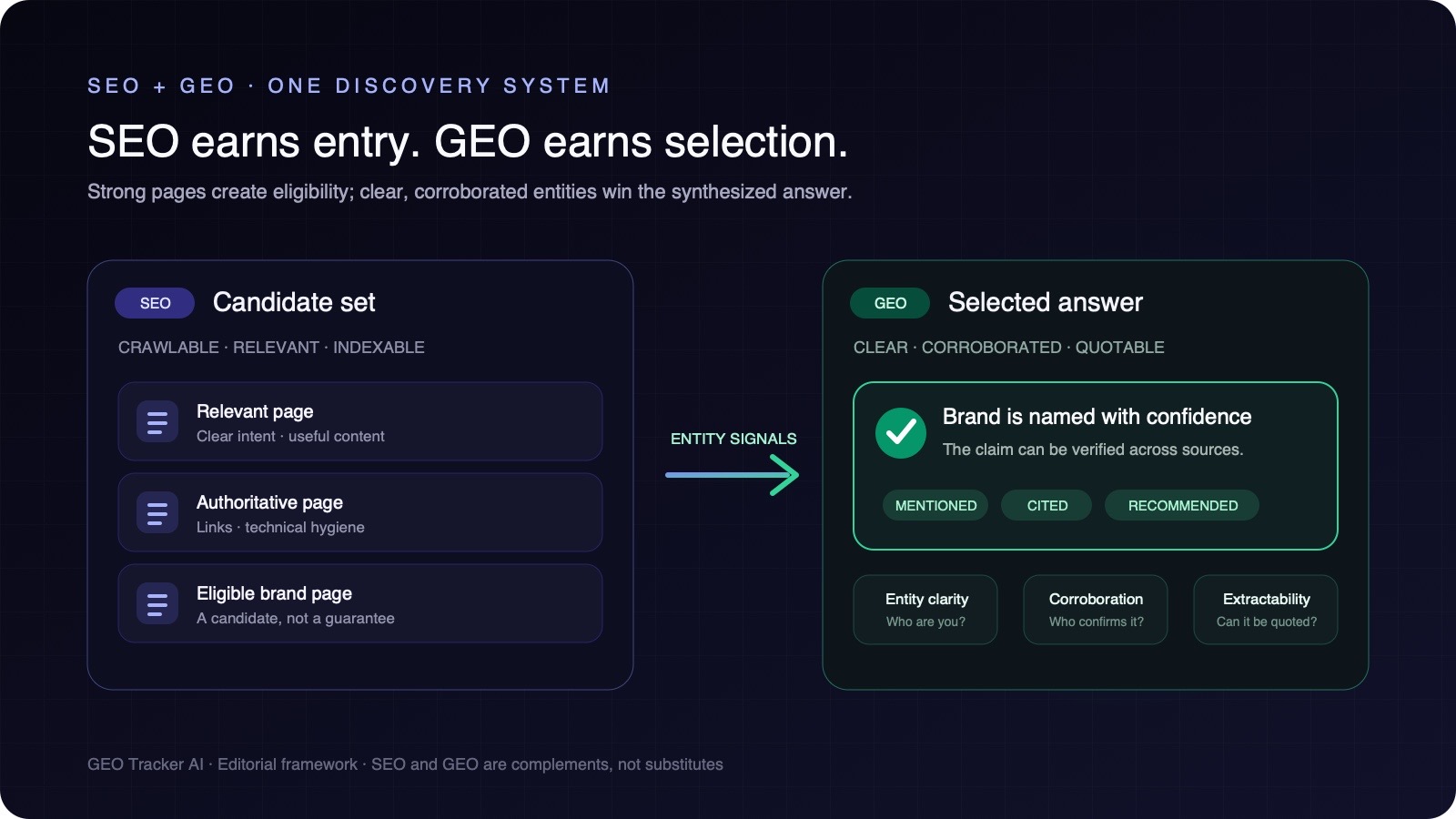
The core difference (entity clarity)
The distinction starts with what the user receives.
SEO success means earning visibility in a ranked list of results and capturing clicks from that list. You optimize pages, internal linking, and relevance signals so a search engine can match queries to your URLs.
GEO success means your brand is represented in a synthesized answer: mentioned, compared, linked as a source, or omitted. There is often no stable rank position analogous to “#3 in SERP,” because the output is generated and can vary by interface, model, personalization, and query framing.
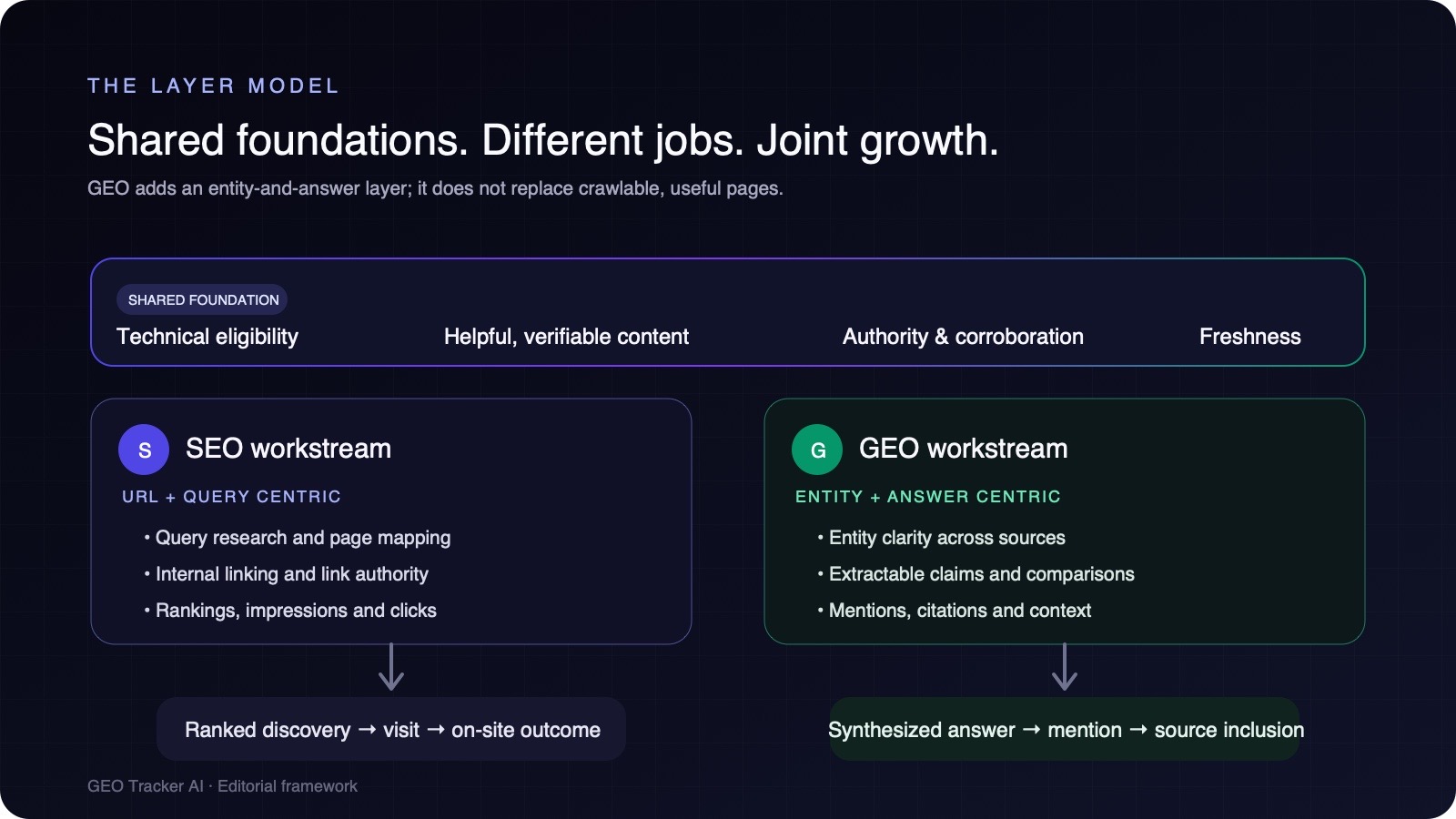
This matters for resourcing: SEO is often URL-centric (which page should rank). GEO is often entity-centric (what the ecosystem “knows” about your brand and which sources models and retrieval systems trust).
Neither replaces the other in most go-to-market motions.
Where SEO and GEO overlap (and what Google confirms)
Before splitting strategies, it is useful to separate facts from team folklore.
Google’s Search Central documentation for AI features explicitly states that the same foundational SEO best practices that apply to Google Search overall apply to AI features such as AI Overviews and AI Mode, and that there are no additional technical requirements to be eligible to appear as a supporting link — beyond normal indexing/eligibility expectations.
In plain language: if your site is hard to crawl, unclear, thin, or low-trust for classic Search, you should not expect AI-mediated surfaces to magically treat it as authoritative.
Source: developers.google.com/search/docs/appearance/ai-features
High-quality, verifiable content
Thin pages and vague marketing copy tend to underperform in classic Search and are also weak inputs for systems that summarize the web. Useful, specific, well-structured pages are easier to quote, link, and corroborate.
Authority and corroboration signals
Links, mentions, and third-party corroboration still function as ecosystem trust signals. The mechanism is not identical to “PageRank → position #4,” but consistent corroboration across independent sources is aligned with how credible answers are built.
Technical crawl and indexing hygiene
If crawlers cannot reliably fetch and parse your content, or if your site signals are contradictory (canonicalization, duplicates, blocked sections), you reduce the chance your pages participate as high-quality sources.
Structured data (useful, but not a magic lever)
Organization, SoftwareApplication, FAQPage, and related schema can clarify entities and claims for machines. Google’s AI-features documentation emphasizes that there is no special schema requirement to appear in those experiences — so treat structured data as clarity and consistency, not a cheat code.
Directional third-party context (not universal laws)
This section exists because teams still ask for “one number” to justify investment. The defensible move is to cite named studies and keep the interpretation narrow.
AI Overviews and click behavior (third-party methodology)
Ahrefs published analyses estimating how AI Overviews correlate with lower organic CTR, including an updated write-up reporting a large CTR reduction for position-one pages on queries where AI Overviews appear (their methodology and time window are part of the claim — read the primary post).
- Ahrefs — AI Overviews reduce clicks: ahrefs.com/blog/ai-overviews-reduce-clicks/
Interpretation: treat this as evidence that SERP UI changes can decouple “rank” from “clicks,” not as a guaranteed outcome for your site.
Zero-click / low-click behavior (third-party clickstream)
SparkToro (with Datos clickstream) published a widely cited study estimating that a large share of Google searches end without a click to the open web, with different headline figures for US vs EU — definitions matter (what counts as a “click,” what counts as “Google,” etc.).
- SparkToro — Zero-click Google searches, 2024: sparktoro.com/blog/2024-zero-click-search-study-for-every-1000-us-google-searches-only-374-clicks-go-to-the-open-web-in-the-eu-its-360/
Interpretation: this supports the strategic point that “ranking” alone may not capture demand capture — not that any single percentage is stable forever.
Macro forecasts (press-release context)
Gartner’s press materials include forward-looking statements about shifts in how people use search engines vs AI assistants. Forecasts are inherently uncertain — cite them as forecasts, not present-tense facts.
- Gartner — Press release (Feb 2024): www.gartner.com/en/newsroom/press-releases/2024-02-19-gartner-predicts-search-engine-volume-will-drop-25-percent-by-2026-due-to-ai-chatbots-and-other-virtual-agents
Where SEO and GEO diverge
Here is where planning should split — not because “SEO stopped mattering,” but because the user interface and attribution story changed.
| Dimension | SEO (classic SERP framing) | GEO (AI answer framing) |
|---|---|---|
| Primary unit of work | Pages and queries | Brand entity + citeable passages + corroboration |
| Typical success signals | Rankings, impressions, clicks | Mention presence, mention context, source inclusion, stability over time |
| Competitive lens | Who ranks above your URL | Who is named or cited when buyers ask decision questions in AI interfaces |
| Content packaging | Strong titles, clear intent match, internal linking | Clear answers, explicit definitions, comparison tables, stable facts |
| Measurement | Search Console, analytics, rank trackers | Prompt monitoring + change tracking (often third-party) |
Keywords vs entities (mental model)
SEO workflows often begin with keyword research and page mapping. GEO workflows should still use customer language, but the operational center shifts to consistent entity modeling: who you are, what category you belong in, what you do and do not do, and where authoritative third parties agree (or disagree).
“Ranking” vs “mention context”
A page can rank well and still be absent from an AI answer for the same underlying intent — depending on what sources the system selects, how the answer is summarized, and whether your brand is named versus only implied.
Passages vs “one perfect page”
Long guides can rank well in classic Search. AI-mediated answers often reward extractable statements: definitions, steps, comparisons, and explicit recommendations that can be summarized with links back to sources.
Effort allocation: use scenarios, not fake precision
There is no universally correct SEO/GEO split without your category, funnel, and data. Any “70/30” style split should be labeled a heuristic and adjusted from measured outcomes.
Practical reading order inside this blog
- Definitions: What Is GEO?
- The symptom in depth: Why you rank #1 on Google but ChatGPT never mentions you
- Crawl policy pitfalls: 5 technical mistakes
- Engine differences: ChatGPT vs Perplexity
- Google surfaces: AI Overviews vs AI Mode
Compounding timelines (avoid invented numbers)
SEO changes frequently play out over multiple update cycles. AI-mediated answers can change quickly for some prompts — but timing depends on interface, retrieval behavior, and competition. Avoid claiming fixed timelines unless you have your own reproducible measurement.
Measuring both without pretending the metrics are identical
Tools for classic SEO
Teams commonly use Google Search Console, analytics, and rank/crawl tooling (for example Ahrefs or Semrush) to understand queries, pages, and links.
Tools for GEO
GEO tooling is less standardized because interfaces differ and full prompt coverage is rarely public. A practical approach is to run a fixed panel of prompts over time and track mention patterns with consistent methodology.
GEO Tracker AI focuses on monitored prompts and visibility trends across supported engines, so you can separate “organic URL performance” from “AI answer presence” in your operating reviews.
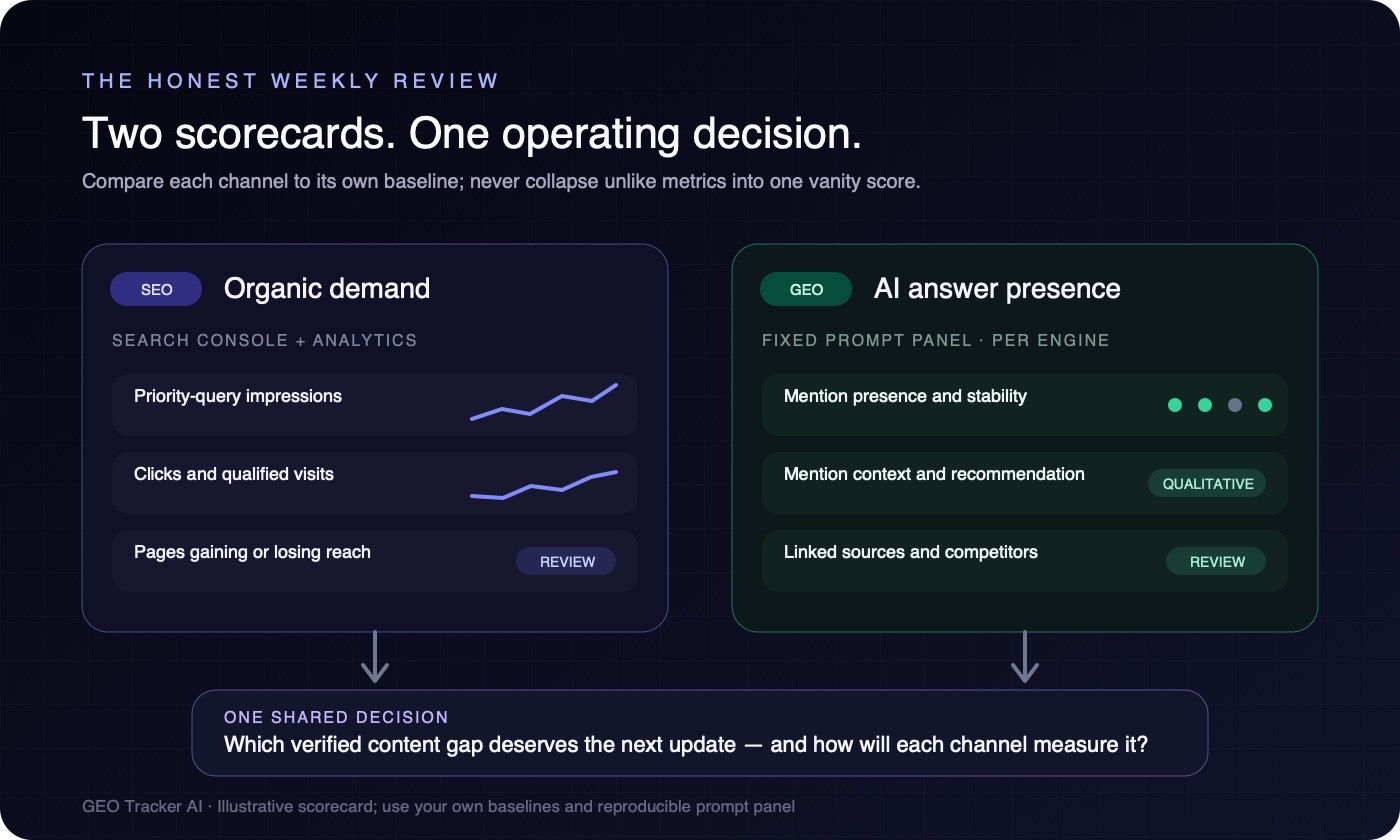
A weekly review that stays honest
- Organic demand: impressions/clicks for priority queries (Search Console).
- AI presence: for a fixed prompt list, did your brand appear, how was it framed, and what sources were linked (your monitoring approach).
- Content gaps: where answers cite competitors or generic guidance, what citeable page would improve specificity?
The bottom line
SEO and GEO are complements. SEO improves eligibility and distribution through ranked results; GEO improves how you show up when answers are synthesized — a different user experience with different failure modes.
If you only optimize classic SERPs, you can still lose narrative share in AI answers. If you only chase AI mentions without crawlable, credible pages, you can lack the sources systems need to cite you responsibly.
Sources and official documentation
- Google Search Central — AI features and your website: developers.google.com/search/docs/appearance/ai-features
- Google — How AI Overviews in Search work (PDF): google.com/search/howsearchworks/google-about-AI-overviews.pdf
- Google — AI Overviews and AI Mode in Search (PDF): search.google/pdf/google-about-AI-overviews-AI-Mode.pdf
- Ahrefs — AI Overviews reduce clicks (third-party study): ahrefs.com/blog/ai-overviews-reduce-clicks/
- SparkToro — Zero-click study (third-party clickstream): sparktoro.com/blog/2024-zero-click-search-study-for-every-1000-us-google-searches-only-374-clicks-go-to-the-open-web-in-the-eu-its-360/
- Gartner — Press release (forecast, not present-tense fact): www.gartner.com/en/newsroom/press-releases/2024-02-19-gartner-predicts-search-engine-volume-will-drop-25-percent-by-2026-due-to-ai-chatbots-and-other-virtual-agents
Frequently asked questions
The same Q&A pairs ship as FAQPage structured data so AI engines can quote them verbatim.
- Will GEO replace SEO?
- No. Google still drives the majority of B2B discovery traffic in 2026 and AI engines lean on the same crawl + authority infrastructure as classic search. GEO adds a new measurement layer on top of SEO — it does not subtract.
- How do I split budget between SEO and GEO in 2026?
- Treat them as overlapping investments, not separate buckets. Most of the technical hygiene (JSON-LD, robots.txt sanity, content depth) earns dual credit. The genuinely GEO-only work — multi-engine measurement, Reddit citation strategy, llms.txt — is cheap enough that even a $5K/mo marketing budget can carry it without cannibalising SEO spend.
- What metric matters more — clicks or AI mentions?
- Both, on different time horizons. Clicks remain the conversion-attributable metric; AI mentions are a leading indicator of brand consideration that won't show in your analytics until a buyer enters your funnel via branded search. Track each separately and don't compare apples to oranges.
- Does Search Console show AI traffic?
- Partially. AI Overviews impressions are folded into the normal Performance report (no separate filter today), and AI Mode traffic appears as the user did land via Search. Neither surface tells you whether you were cited inside the AI answer itself — that requires a multi-engine tracker.
Related articles
Your GEO Score
Establish an AI mention baseline you can defend
GEO Tracker AI runs repeatable checks for supported engines so you can see whether your brand is mentioned, what context shows up, and how that changes week over week — complementary to Search Console, not a replacement for it.