Generative Engine Optimization (GEO): What It Is, How It Works, and How to Measure It
Generative Engine Optimization (GEO) helps brands earn accurate mentions and citations in AI answers. Learn the operating model, how GEO differs from SEO and AI SEO, and how to measure progress without hype.
If you sell software or services online, an increasing share of discovery happens in AI-mediated interfaces: summarized answers in Search, conversational assistants, and AI-native research tools. GEO is the discipline of improving how your brand is mentioned, cited, and described in those contexts — without pretending the ecosystem is static or fully controllable.
Short definition: Generative Engine Optimization (GEO) is the practice of making your public, crawlable presence clear, corroborated, and easy to quote so automated systems can responsibly reuse it when generating answers.
If you arrived looking for AI SEO, use the terms this way: AI SEO is the broad discipline of improving visibility in AI-mediated discovery; GEO is the part of that discipline concerned with how a brand is named, cited, and accurately described in generated answers. Our AI SEO guide covers the wider operating model; this page is the canonical GEO foundation.
Methodology & sources
Editorial review for factual claims (as of 2026-08-25).
- Official guidance is cited for Google AI features in Search (eligibility + “no special requirements” framing).
- Third-party research is cited where we discuss zero-click behavior and referral conversion examples.
- Interpretation: “what to optimize” recommendations below combine documented mechanics with common practitioner experience — not a vendor-published ranking formula.
The short version
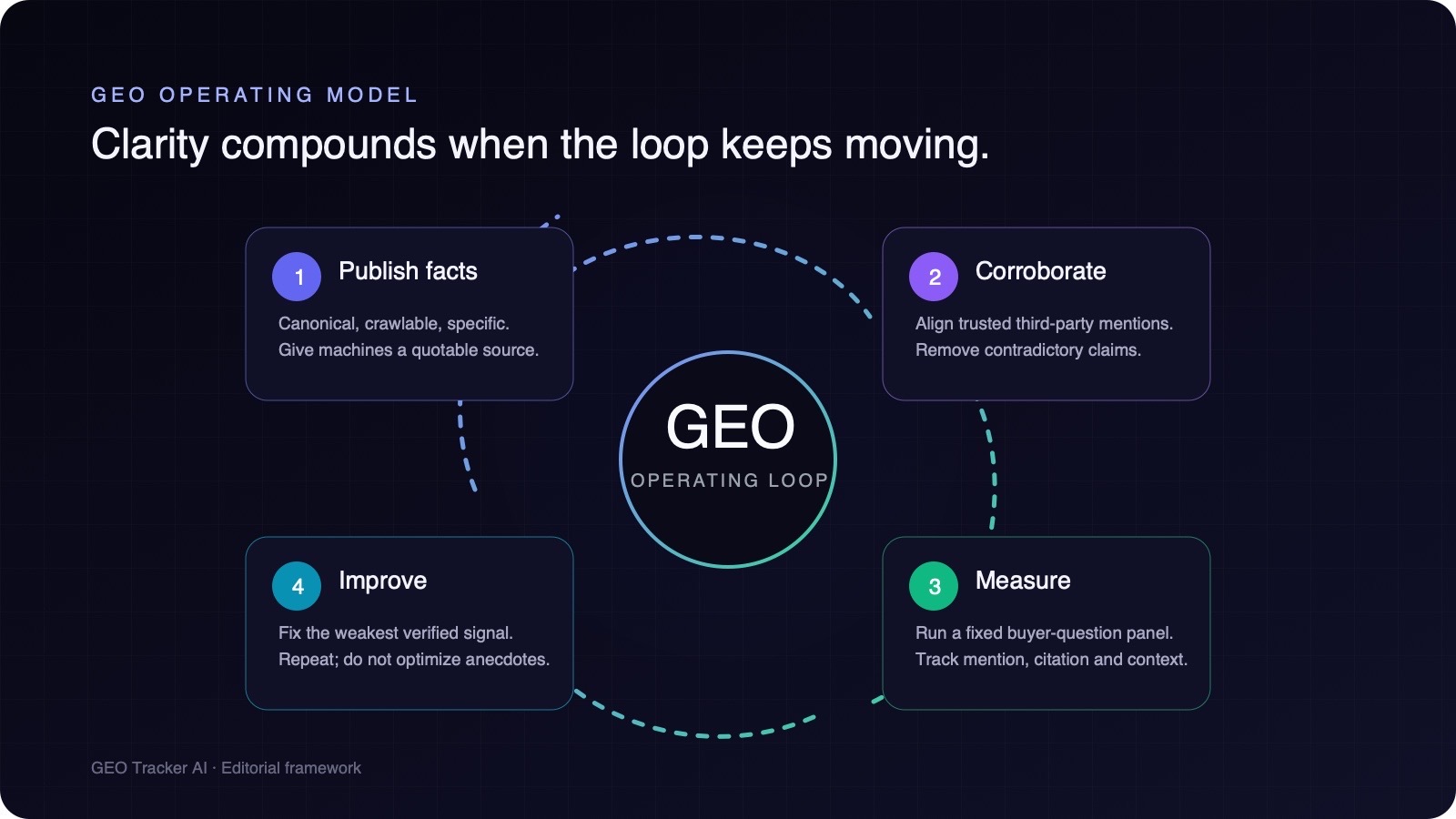
- GEO is an operating model, not a tag or a file. Publish verifiable primary facts on domains you control, align third-party mentions to your canonical claims, and measure a stable buyer-question panel over time.
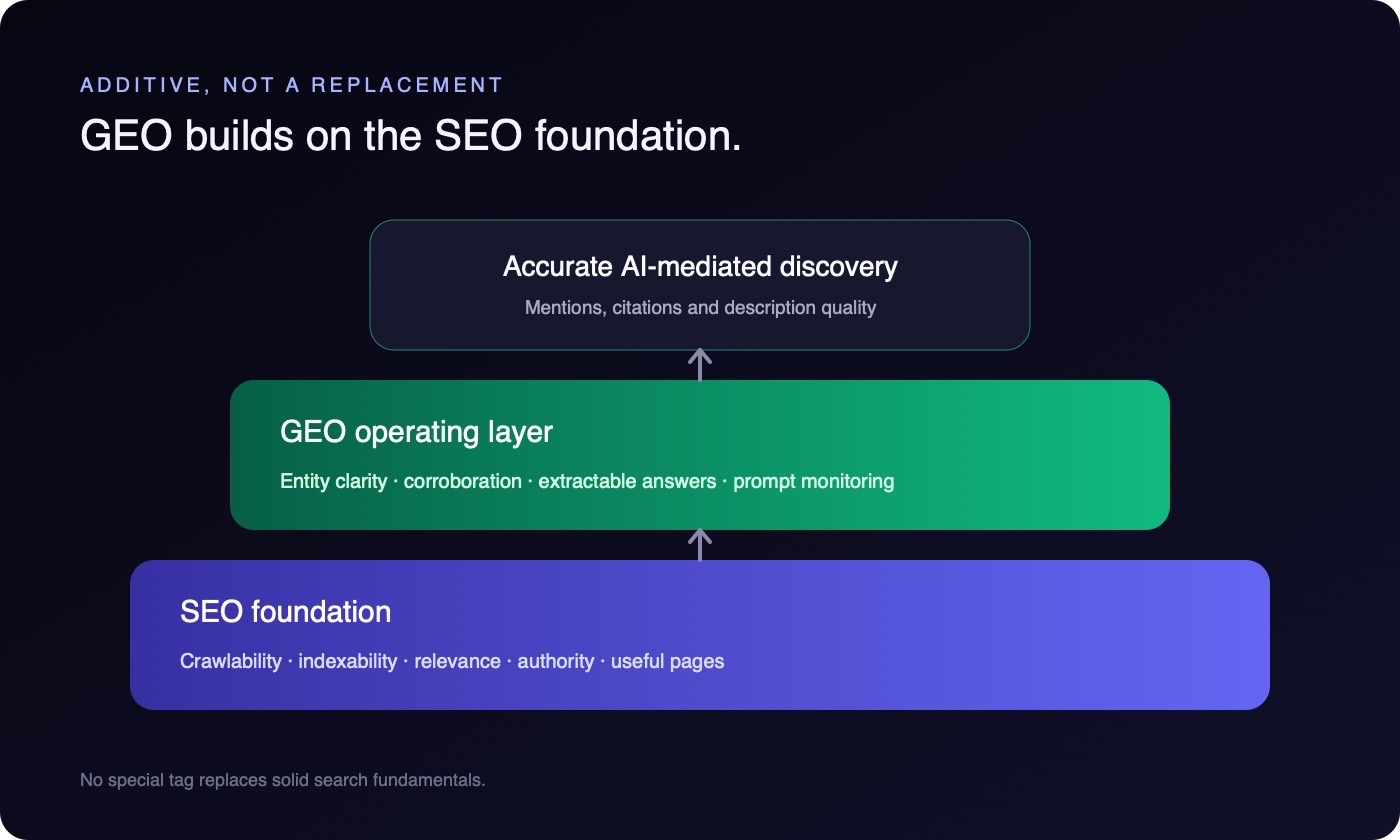
- GEO and SEO are not opposites. Google has stated explicitly that AI features in Search still depend on standard technical eligibility — the work is additive, not a separate stack.
- No “magic schema” or
llms.txttrick will rank you in AI answers. Google has confirmed it does not usellms.txtfor ranking, and rich-result schemas (Article, Product, Organization) work as entity-verification signals, not as AI-citation triggers. - Measurement is the lever. Without a fixed buyer-question panel and a per-engine Share of Voice (also called Share of Model or AI citation rate) over time, every "did GEO work?" conversation collapses into anecdotes.
What GEO is (and is not)
GEO is not a single tag, file, or prompt trick. It is an operating model:
- Publish verifiable primary facts on domains you control (pricing rules, boundaries, integrations, security posture where public).
- Align ecosystem mentions so third parties do not contradict your canonical claims.
- Measure a stable buyer question set over time (manual or tool-assisted).
Traditional SEO is still about earning visibility and clicks from ranked results. GEO overlaps with SEO because eligibility and clarity still depend on crawlable, high-quality pages — especially in Google’s AI features, where Search Central explicitly ties AI surfaces to standard Search fundamentals.
Source: Google Search Central — AI features and your website: developers.google.com/search/docs/appearance/ai-features
Fact vs interpretation (read this once)
- Fact (Google-published): AI features in Search surface supporting links; Google states there are no additional technical requirements beyond normal Search eligibility for inclusion as a supporting link, and no special schema “requirement” for those features.
- Interpretation (industry): structured data and FAQ-shaped pages can still help machines extract answers — this is not the same as a guaranteed inclusion switch.
How different systems use the web (high level, vendor-grounded)
ChatGPT: training priors vs documented search bots
ChatGPT-family experiences can combine training-time priors with retrieval/product features, depending on the surface and settings — details change, so treat product behavior as something to verify in-release.
For policy-relevant controls, OpenAI documents separate crawlers:
OAI-SearchBot: used to surface websites in ChatGPT search features (search inclusion).GPTBot: used for training-data collection workflows (training opt-out semantics).ChatGPT-User: user-initiated fetching; OpenAI states robots rules may not apply to these user actions, and thatChatGPT-Useris not used to determine Search inclusion.
Source: OpenAI — Overview of OpenAI Crawlers: developers.openai.com/api/docs/bots
Perplexity: indexing bot vs user-initiated access
Perplexity documents PerplexityBot and Perplexity-User separately. It also states that user-initiated fetching generally ignores robots.txt.
Source: Perplexity — Perplexity crawlers: docs.perplexity.ai/guides/bots
Google Search: AI Overviews and AI Mode
Google describes AI Overviews and AI Mode as AI features in Search with links to supporting content, and notes AI Mode and AI Overviews may use different models and techniques (so outputs can differ).
Sources:
- Google Search Central — AI features and your website: developers.google.com/search/docs/appearance/ai-features
- Google — AI Overviews and AI Mode in Search (PDF): search.google/pdf/google-about-AI-overviews-AI-Mode.pdf
GEO vs SEO: key differences (mental model)
| Dimension | SEO | GEO |
|---|---|---|
| Primary goal | Earn ranked visibility and clicks | Earn accurate mentions and appropriate source inclusion in AI-mediated answers |
| Primary metrics | Rankings, impressions, clicks | Mention presence, mention context, linked sources, stability over time |
| Primary levers | Information architecture, relevance, links, technical SEO | Same foundations, plus entity consistency + extractable passages + prompt monitoring |
| Measurement | Search Console + analytics | Search Console + fixed prompt panel (manual or tool-assisted) |
For a deeper comparison, read GEO vs SEO in 2026.
Why “AI referrals” can matter (case study, not a universal benchmark)
Third-party analytics firms sometimes publish single-site analyses with transparent methodology windows. One example: Seer Interactive reported conversion-rate differences between referral channels in a GA4 case study (including ChatGPT and Perplexity vs Google Organic) for a specific site and time window.
How to use this responsibly: replicate measurement for your domain with consistent UTM hygiene — do not treat a case study as a category-wide law.
Source: Seer Interactive — Case study: how traffic from ChatGPT converts: seerinteractive.com/insights/case-study-6-learnings-about-how-traffic-from-chatgpt-converts
Zero-click framing (third-party clickstream)
Discussions about “SEO traffic risk” often reference zero-click behavior in Google. A widely cited public analysis is SparkToro’s clickstream-based study (with Datos), which estimates large shares of searches end without a click to the open web — definitions and markets matter.
Source: SparkToro — Zero-click Google searches, 2024: sparktoro.com/blog/2024-zero-click-search-study-for-every-1000-us-google-searches-only-374-clicks-go-to-the-open-web-in-the-eu-its-360/
Interpretation: even strong organic positions can be less visible in “clicks” than leadership dashboards imply — which is why GEO complements SEO rather than replacing measurement discipline.
How to start (realistic action sequence)
Step 1: Baseline prompts (cheap, high signal)
Write 10–20 buyer questions you care about (“best X for Y,” “how to evaluate Z,” “A vs B for use case C”). Run them consistently weekly and record: mentioned? cited? linked? positive/neutral/negative?
Step 2: Fix eligibility blockers
If you have not mapped crawl policy to outcomes, start with 5 technical mistakes — especially bot roles (OAI-SearchBot vs GPTBot vs user-initiated agents).
Step 3: Improve extractability
Put answers early, use question-shaped headings, and keep canonical facts on public URLs (not behind auth walls).
Step 4: Monitor over time
GEO is a process: models, SERP UI, and competitors change. The goal is a defensible trend line for your prompt panel — not a single screenshot.
The bottom line
GEO is the practical response to a simple shift: people increasingly get recommendations and summaries from AI-mediated surfaces, not only from clicking through ranked links. The durable playbook is still credible publishing: clear facts, corroboration, technical eligibility — plus measurement that treats AI answers as first-class inputs.
Sources and official documentation
- Google Search Central — AI features and your website: developers.google.com/search/docs/appearance/ai-features
- OpenAI — Overview of OpenAI Crawlers: developers.openai.com/api/docs/bots
- Perplexity — Perplexity crawlers: docs.perplexity.ai/guides/bots
- Google — AI Overviews and AI Mode in Search (PDF): search.google/pdf/google-about-AI-overviews-AI-Mode.pdf
- SparkToro — Zero-click study (third-party clickstream): sparktoro.com/blog/2024-zero-click-search-study-for-every-1000-us-google-searches-only-374-clicks-go-to-the-open-web-in-the-eu-its-360/
- Seer Interactive — GA4 case study (single-site; not a universal benchmark): seerinteractive.com/insights/case-study-6-learnings-about-how-traffic-from-chatgpt-converts
Frequently asked questions
The same Q&A pairs ship as FAQPage structured data so AI engines can quote them verbatim.
- What is GEO?
- GEO (Generative Engine Optimization) is the discipline of improving how a brand is mentioned, cited, and described in AI-mediated answer surfaces — ChatGPT, Perplexity, Google AI Mode, Claude. It complements rather than replaces classic SEO.
- How is GEO different from SEO?
- SEO optimises a page so it ranks in a list of blue links. GEO optimises an entity (your brand) so it gets mentioned inside the answer an AI engine generates — even when no click reaches your site. The shared substrate is high-quality, machine-readable content; the failure modes diverge.
- Which AI engines does GEO cover?
- In 2026 the engines that matter are ChatGPT (via OpenAI search), Perplexity (Sonar retrieval), Google AI Mode and AI Overviews, Claude (Anthropic), Gemini, and Microsoft Copilot. Each picks citations differently, which is why multi-engine measurement matters more than optimising for any single one.
- How do you measure GEO performance?
- Three metrics converged across the category: Share of Voice (how often AI engines mention your brand on a panel of buyer questions), AI citation count per engine over time, and the 14-day outcome of specific shipped actions. Anchor measurement to a fixed prompt panel so weekly retrieval drift looks like noise, not regression.
Related articles
Your GEO Score
Establish an AI mention baseline you can defend
GEO Tracker AI runs repeatable checks for supported engines so you can see whether your brand is mentioned, what context shows up, and how that changes week over week — complementary to Search Console, not a replacement for it.