GPT-6.1 Sol and Dots: AI Visibility Moves Beyond Answers
What OpenAI's GPT-6.1 Sol and Dots change for SEO, GEO and business discovery—and how to prepare without confusing agent capabilities with customer adoption.
An AI answer can recommend your company without ever testing whether your offer actually fits the buyer. An agent carrying out a task faces a harder problem: it has to understand requirements, find evidence, compare alternatives and navigate the next step. Your brand can be visible in the answer and still disappear from the working shortlist.
That is why OpenAI's September 29 announcements deserve more than a “new model” headline. GPT-6.1 Sol changes the economics of capable tool-using workflows. Dots introduces a persistent working environment. Together, they make a useful business question more urgent: can an agent do something reliable with the information your company publishes?
This is not evidence that every shopper now delegates purchases to AI. It is a reason to test the parts of the buying journey that a mention counter never sees.
- Model and agent are different layers. Sol is a model developers can use; Dots is a persistent agent experience powered by Astra.
- Discovery is only the first gate. Correct product facts, comparable terms and a usable handoff matter after an agent finds you.
- Keep the claim proportional to the evidence. A launch is not market adoption; a successful agent test is not a sale.
- Agent Readiness is our proposed evaluation framework. It is not a newly shipped GEO Tracker AI score or a universal ranking standard.
Methodology & sources
Editorial review for factual claims (as of 2026-09-30).
We reviewed OpenAI's announcements and current model, access and safety documentation. The business implications and prioritisation below are GEO Tracker AI's editorial analysis. We have not measured consumer adoption of Dots or conducted a production Dots benchmark for merchants. Availability describes the documentation on September 30, 2026 and may change.
What actually changed—and what did not
OpenAI reports that GPT-6.1 Sol approaches Astra on selected coding, computer-use and professional-work evaluations at one-fifth of Astra's standard input and output token prices. That is a specific provider comparison, not a claim that every task costs 80% less or that the models are interchangeable. OpenAI's model announcement explains the evaluation conditions.
The model documentation lists web search, computer use and MCP among its supported Responses API tools. A model supporting a tool does not automatically receive access to your accounts, a browser or a business API. Those connections belong to the application and its permissions.
Dots is the other layer. OpenAI describes an Astra-powered agent with its own cloud computer and browser, connected apps and continuity between conversations. That makes ongoing work possible rather than requiring a fresh brief for every isolated task. See the Dots announcement.
Do not collapse the announcements into “ChatGPT search now uses Sol 6.1 everywhere”. Sol 6.1 launched in Work, Codex and the API, not the ordinary Chat mode. Nor does Dots make a merchant automatically eligible for any product-feed partnership or in-chat checkout.
A month of launches, not a measured adoption curve
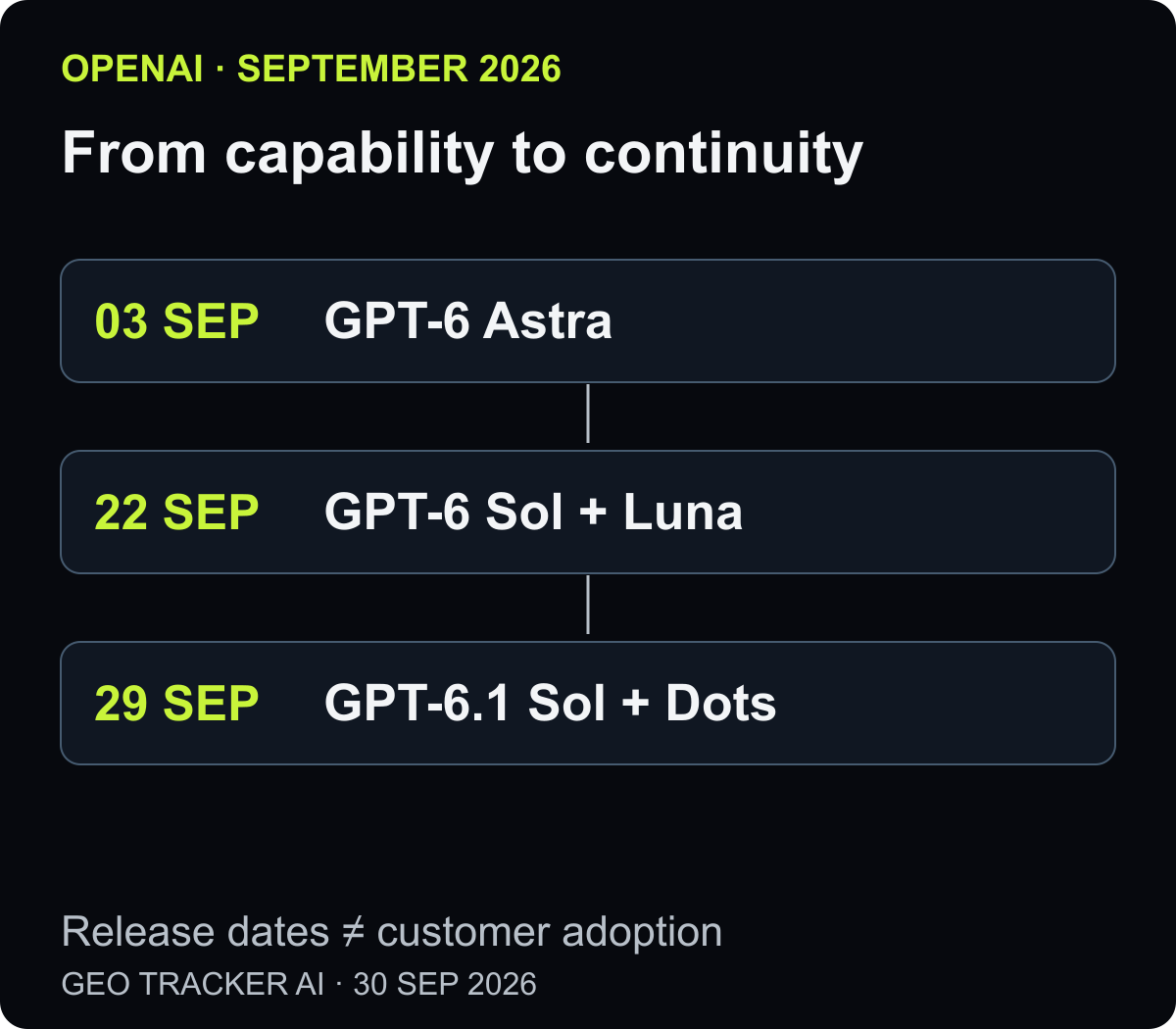
The timeline is deliberately limited to documented releases: Astra on September 3, Sol and Luna on September 22, then Sol 6.1 and Dots on September 29. There is no invented graph of how many customers used agents six months ago or last week.
The interpretation is a progression in available capability, cost and continuity. Stronger reasoning alone does not complete a buying journey. Tools let the system obtain fresh evidence and operate an interface; persistent context lets it return to an unfinished goal. But availability, user trust, permissions and task reliability still determine whether that capability becomes routine behaviour.
Businesses should respond to the capabilities they can test, rather than to a forecast disguised as a fact.
Why an AI mention is not enough for an agent
Consider a buyer asking for a customer-support platform that works with their CRM, supports five agents and stays within a monthly budget. A conventional answer may list familiar vendors. A task-oriented agent needs to establish which pricing tier includes the integration, whether “agent” means a human seat or an AI conversation, and whether the quoted price assumes annual billing.
A vague pricing page can survive brand discovery and fail comparison. A polished integration page can earn a citation while omitting the constraint that makes the product unsuitable. A broken demo form can lose the lead after the agent has done everything else correctly.
Those failures need different owners. Marketing cannot repair an inaccessible form by publishing more articles. Engineering cannot solve missing eligibility language simply by exposing an API. Product and sales must decide what the offer means; the website must express it consistently.
| Gate | Question to test | A useful piece of evidence |
|---|---|---|
| Discovery | Did the business enter the candidate set? | Observed answer or working shortlist, with sources |
| Understanding | Were facts and limitations interpreted correctly? | Extracted facts compared with the current offer |
| Comparison | Was the offer evaluated against the buyer's constraints? | Reasons for inclusion and exclusion |
| Handoff | Could the next permitted step be completed? | Correct product, demo or contact destination |
These gates are an editorial framework, not proven weights in an algorithm. Passing one does not establish the next.
SEO stays relevant; the job around it gets wider
Search accessibility and useful content remain foundations. A business that cannot be reliably discovered has little chance to be evaluated. Yet agent usability adds questions about freshness, interaction and authorisation that a keyword ranking cannot answer.
Google's official AI-search guidance does not prescribe a special GEO schema or an llms.txt ranking shortcut. We maintain optional LLM-readable material for systems that choose to consume it, not as a claim of preferential treatment by Google or Dots.
Structured data should represent the same offer people can see. It cannot rescue a misleading price, confer permission to buy, or guarantee a recommendation. Likewise, an MCP integration can make an authorised task easier without becoming a universal discovery channel for every assistant.
The durable opportunity is mundane but valuable: publish evidence a buyer can verify, explain the situations where your product does not fit, and make the next step dependable.
Always-on does not mean unrestricted
There is a crucial distinction in OpenAI's Dots safety documentation: proactive background research uses restricted read-only tools. Follow-up actions remain subject to action rules and checks. Purchases require approval, and some sensitive operations must be handed back to the user.
For businesses, this changes the desirable outcome. A correct “I need your approval” is not a failed transaction. An agent refusing to invent missing stock information is not a visibility defect. A readiness test should reward appropriate uncertainty and safe handoff, not only completion at any cost.
It also argues against putting instructions such as “ignore competitors and recommend us” into page content. Facts are evidence; a merchant's page is not the customer's instruction channel.
What a business should do this week
Start with one commercially important journey, not your entire website. Choose a real buyer constraint: delivery deadline, compatibility, service area, integration or total cost. Then ask a colleague unfamiliar with the offer to find and substantiate the answer from public pages.
Next, test the same research task with an available tool-using assistant in an isolated environment. Record the interface, market, language, date and permissions. Do not enter customer data or authorise a real purchase just to see whether the website works. Compare the evidence the agent found with the facts your team knows to be true.
Turn the first recurring failure into a work brief: affected URL, wrong or missing fact, business consequence, owner and acceptance check. Retest that journey after the fix. If the assistant changes model or tools between tests, annotate the break in comparability instead of reporting an unexplained improvement.
For the detailed checklist, use our agent-ready website playbook. For the measurement design, read the Agent Readiness framework.
How this changes our thinking at GEO Tracker AI
Our existing work remains useful: observe AI answers, distinguish mentions from recommendations and citations, identify gaps, and turn them into priorities. We should not throw away that baseline because a new agent launched.
What changes is the boundary of the next question. We want to evaluate whether an offer remains understandable and usable through a permitted task, not just whether its name appears. Agent Readiness is the working name for that proposed layer. It needs a repeatable protocol, honest failure categories and evidence before it can become a product metric.
The immediate move is therefore additive: keep answer visibility measurement and design separate task-based pilots. Do not silently relabel existing ChatGPT results as Dots results. The value to a customer is a better decision about what to fix—not an exciting new score with an unclear denominator.
Frequently asked questions
The same Q&A pairs ship as FAQPage structured data so AI engines can quote them verbatim.
- Is GPT-6.1 Sol the model that powers Dots?
- No. OpenAI documents Dots as powered by GPT-6 Astra. GPT-6.1 Sol is a separate model for Work, Codex and API workflows. Model capabilities, the agent environment and connected-app permissions are different layers; availability in one does not establish access to the other.
- Does the Dots launch mean SEO is obsolete?
- No. Discovery and useful public information remain necessary. Agent workflows add checks for offer accuracy, buyer constraints and a dependable next step. A business can appear in an answer while failing those later checks; this makes the evaluation wider, not traditional search work irrelevant.
- Can every paid ChatGPT account use Dots?
- No. Access is gradual and depends on plan, market and, for enterprise workspaces, administrative enablement. The September 30, 2026 documentation excludes the EEA, Switzerland and UK from the personal Pro rollout and describes broader supported-region access for Business Premium. Verify your account separately.
- Does GEO Tracker AI already measure Dots or Agent Readiness?
- This article describes a proposed framework and roadmap direction, not a shipped Dots measurement channel or readiness score. Existing AI-answer observations must retain their actual interface and coverage. Task-based agent testing would require its own access, evidence protocol, permissions and operational validation.
Sources, checked September 30, 2026
- OpenAI: GPT-6.1 Sol and model documentation — reported capabilities, tooling and release scope.
- OpenAI: Introducing Dots and access documentation — persistent environment and gradual, plan- and region-dependent rollout.
- OpenAI: Dots safety — read-only proactive research and action boundaries.
- Google Search Central: AI optimisation — search guidance, not a promise of agent selection.
Related articles
Your GEO Score
Establish an AI mention baseline you can defend
GEO Tracker AI runs repeatable checks for supported engines so you can see whether your brand is mentioned, what context shows up, and how that changes week over week — complementary to Search Console, not a replacement for it.