Why You Rank #1 on Google but ChatGPT Never Mentions You
Ranking #1 on Google does not get you cited by ChatGPT. They are two different selection systems. Here is the mechanism — vendor-grounded — and the realistic fix sequence, without the 'magic schema' myths.
You hold position #1 for your category. Your organic traffic is healthy. Then you ask ChatGPT "what's the best tool for [your category]?" — and your brand isn't in the answer. A competitor you outrank on Google is.
TL;DR: Ranking and citation are two different selection systems. A Google rank orders a list of links for a human to click. An AI engine generates a single answer and names a few brands inside it — and it chooses those names using entity authority, corroboration across sources, content recency, and extractability, not your blue-link position. Strong SEO gets you into the candidate set the engine pulls from; it does not get you named. The fix is not a magic tag — it is making your brand easy to quote, corroborated off-site, and measured per engine over time.
Methodology & sources
Editorial review for factual claims (as of 2026-06-25).
- Vendor-published facts (how each engine retrieves, which bots do what) are cited to Google, OpenAI, and Perplexity primary docs.
- The rank↔citation overlap collapse is reported by third-party analysis (Ahrefs) and cross-referenced to our own GEO myths breakdown, where the fuller sourcing lives. Treat the exact percentages as directional, not laboratory-precise.
- "What to do" recommendations combine documented mechanics with practitioner experience — not a vendor-published ranking formula. Nobody has one.
The short version
- Rank ≠ citation. Google ranks pages; AI engines name entities inside a generated answer. Being #1 makes you eligible, not chosen.
- The old shortcut is breaking. The share of Google AI Overview citations that come from top-10 organic results fell from 76% to 38% in seven months (Ahrefs) — so "just rank and you'll be cited" is a weaker bet every quarter.
- Each engine picks differently. ChatGPT (search mode via
OAI-SearchBot), Perplexity (Sonar, citation-first), and Google AI Mode (organic + heavy UGC) draw from different source mixes. Optimising for one is not optimising for all. - There is no magic schema.
llms.txtis not a ranking signal and JSON-LD is entity verification, not a citation trigger. The levers that work are entity clarity, third-party corroboration, extractable answers, freshness — and measurement.
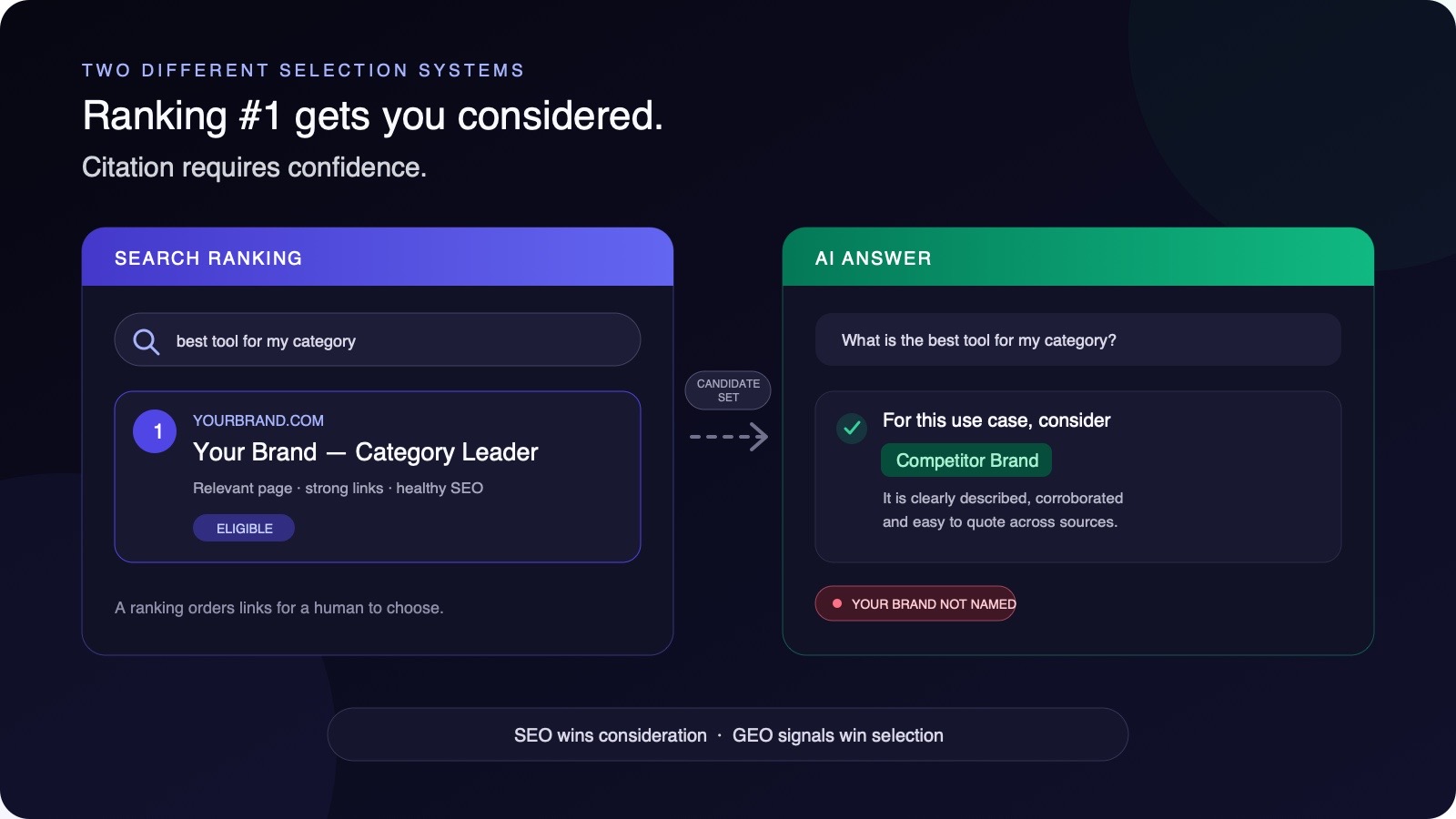
The short answer: ranking and citation are different jobs
A search ranking answers one question: of all the pages about this topic, which order should a human see them in? You win it with relevance, links, and technical SEO.
An AI answer does something else entirely. It writes a paragraph and decides which brands to name inside that paragraph. That is a generation decision, not a ranking decision. The engine assembles a small candidate set (often, but not only, from search results), then selects which entities to mention based on how confidently it can describe them, how often other sources corroborate them, and how cleanly it can lift a quotable claim.
Your #1 ranking buys you a ticket into the candidate set. It does not buy you a seat in the answer.
This article is the symptom-level deep dive. For the broader strategic split — budget allocation, success signals, and a side-by-side measurement framework — read GEO vs SEO in 2026.
Why #1 on Google ≠ cited by ChatGPT
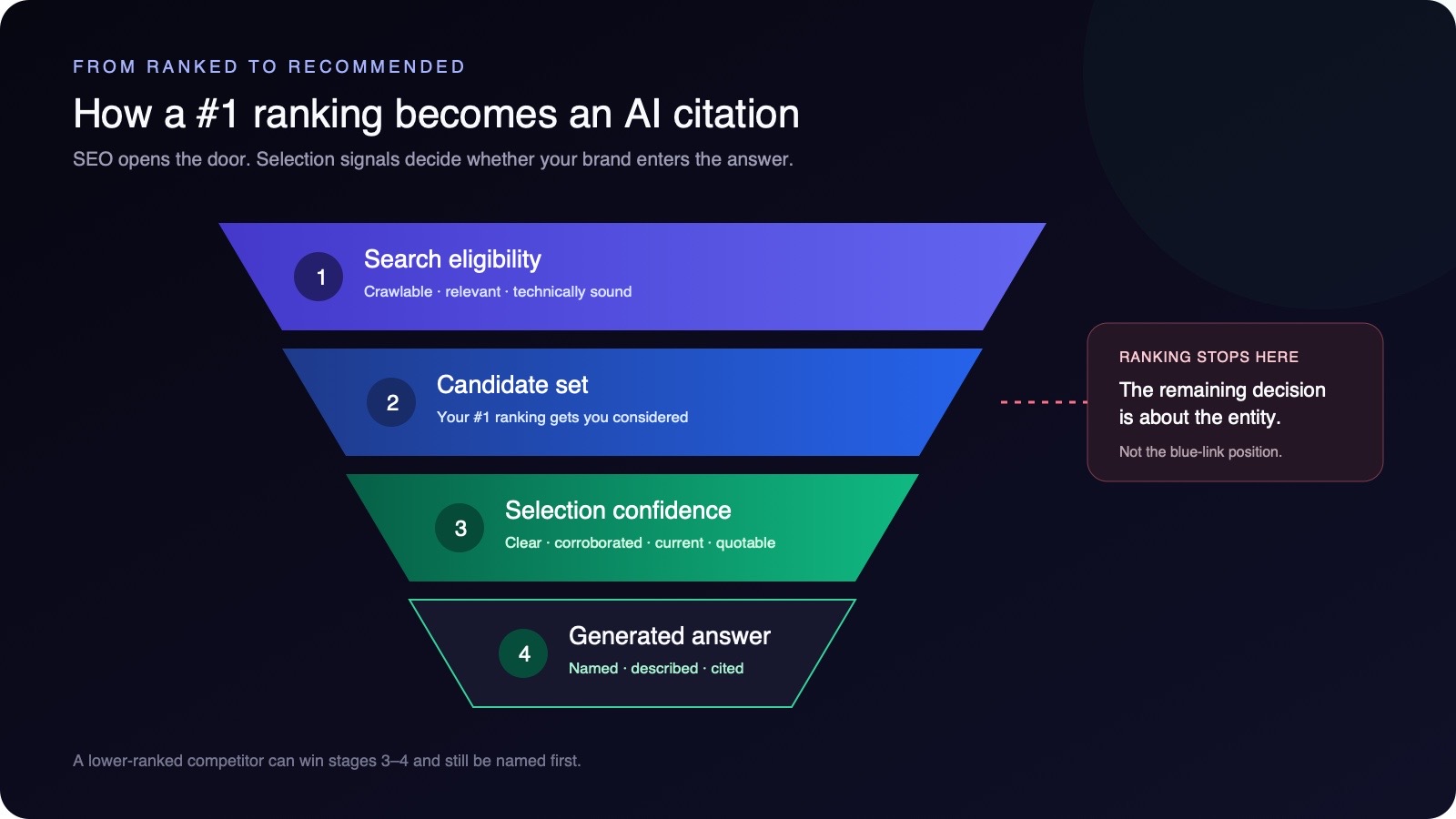
Google itself is explicit that AI features in Search still depend on standard Search eligibility — the AI work is additive to SEO, not a separate stack. So your ranking absolutely matters: it is often how you get considered. (Google Search Central — AI features and your website)
The problem is what happens after consideration. Within the candidate set, the selection signals are not your rank. They are:
- Entity authority — does the engine have a clear, corroborated model of who you are?
- Corroboration — do independent third-party sources describe you the same way?
- Recency — has the page been meaningfully updated recently?
- Extractability — is there a clean, self-contained sentence the engine can quote?
And the historical shortcut — "rank well and the citations follow" — is measurably weakening. Ahrefs analysed 863,000 keywords and found the share of Google AI Overview citations coming from top-10 organic results fell from 76% (July 2025) to 38% (February 2026) — BrightEdge and 5W Research measured the same collapse independently. Rank is becoming a weaker predictor of citation, not a stronger one. (Full cross-checks in our GEO myths breakdown.)
That is why a brand you outrank can be cited while you are not: they are winning the selection signals even though you are winning the ranking one.
How each engine actually picks who it names
There is no single "AI." Three surfaces dominate B2B discovery in 2026 and each selects sources differently — which is why multi-engine measurement beats optimising for any one. (For the deep ChatGPT-vs-Perplexity citation mechanics, see ChatGPT vs Perplexity.)
ChatGPT — search mode vs closed-book
ChatGPT cites sources when it is in search mode, where OpenAI's OAI-SearchBot retrieves live results. In closed-book mode it summarises from training knowledge with no citations at all. The user usually cannot tell which mode fired — so you have to be present in both training-era corpora and live-retrievable today. Note the bot split: GPTBot is the training crawler; OAI-SearchBot is the search/citation crawler. Blocking GPTBot does not stop ChatGPT from citing you — but blocking OAI-SearchBot does. (OpenAI — Overview of OpenAI Crawlers)
Perplexity — citation-first by design
Perplexity's Sonar retrieval is citation-first: every answer is backed by retrieved URLs (typically several fetched, a few cited inline). No retrieval, no answer. That makes Perplexity the most "SEO-adjacent" engine — but it leans heavily on community sources like Reddit, so classic on-site SEO alone won't carry you. (Perplexity — crawlers)
Google AI Mode — organic plus heavy UGC
Google describes AI Overviews and AI Mode as AI features that may use different models and techniques than classic Search, so outputs differ from the blue links you rank in. AI Mode in particular draws heavily from Reddit, YouTube, and forum content alongside organic results. Strong classic SEO is a prerequisite, not a guarantee. (Google — AI Overviews and AI Mode, PDF)
The takeaway: the same brand can be cited by Perplexity, skipped by ChatGPT, and partially named by Google AI Mode in the same week. One ranking, three different verdicts.
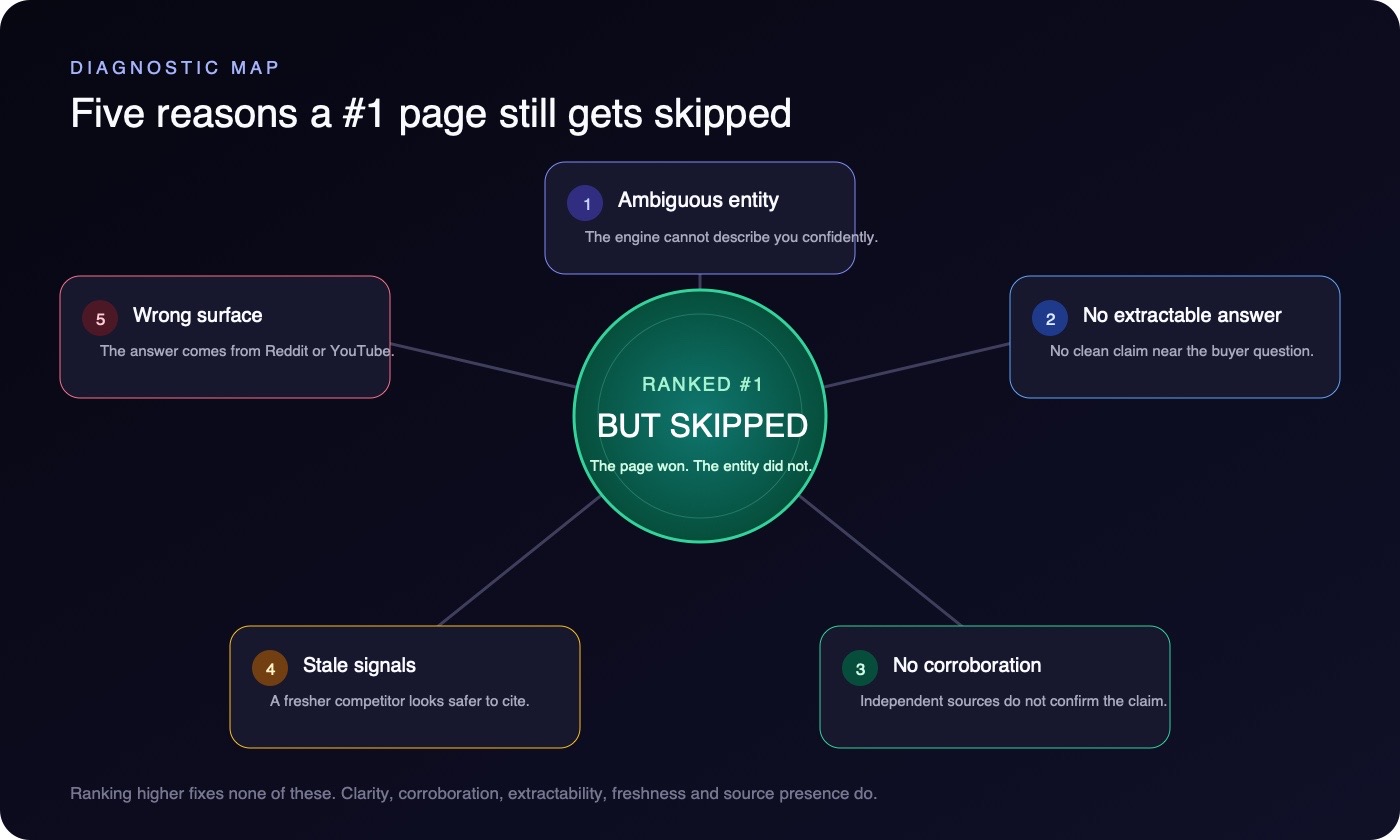
The five reasons a #1 page gets skipped
When a top-ranked page isn't named in AI answers, it's almost always one of these. Read them as the diagnosis — the symptom from the engine's side. The hands-on technical remediation for each (robots.txt bot roles, JSON-LD, brand-string consistency) lives in 5 technical mistakes that reduce AI citation eligibility:
- Ambiguous entity. The engine isn't confident what your brand is. Inconsistent name strings, missing or contradictory JSON-LD, and no Wikipedia/Wikidata/LinkedIn corroboration leave you fuzzy — and engines don't name what they can't describe.
- No extractable answer. Your page ranks because it's comprehensive, but it never states a clean, self-contained claim near a question-shaped heading. There's nothing to lift.
- No third-party corroboration. You say you're the best X; no independent source agrees. Roughly the majority of citations trace to earned third-party media, not your own domain. If the ecosystem is silent about you, the model has nothing to triangulate.
- Stale freshness signals. AI-cited content skews fresher than typical organic. A page last updated two years ago is a weaker citation candidate than a competitor's recently-refreshed one — even at a lower rank.
- Wrong surface. You optimised the page, but the engine pulls this answer from Reddit or YouTube, where you have no presence.
Notice none of these are fixed by ranking higher. They're fixed by being clearer, corroborated, quotable, fresh, and present where the engine actually looks.
What to do about it (realistic sequence)
You can't optimise what you can't see, so start with measurement, then fix eligibility, then extractability.
Step 1 — Measure per engine, on a fixed panel
Write 10–20 real buyer questions ("best X for Y", "A vs B for use case C"). Run them across ChatGPT, Perplexity, and Google AI Mode consistently and record: mentioned? cited? linked? positive or negative? A fixed panel makes weekly retrieval drift look like noise instead of false alarms. (This is exactly what GEO Tracker AI automates — but a spreadsheet works to start.)
Step 2 — Fix entity clarity
Make your name string identical everywhere. Ship Organization JSON-LD on every page and SoftwareApplication/Product on your homepage — as entity verification, not as a citation trick. Get the basics of Wikipedia/Wikidata/LinkedIn corroboration in place. See 5 technical mistakes.
Step 3 — Make answers extractable
Put a direct, self-contained answer in the first 1–2 sentences under each question-shaped H2. The engine should be able to quote one sentence and have it stand alone.
Step 4 — Earn off-site corroboration and stay fresh
Get named in third-party sources your buyers (and the engines) already trust — including the community surfaces Perplexity and AI Mode lean on. Refresh high-value pages on a real cadence and keep dateModified honest.
The bottom line
A #1 Google ranking and an AI citation are produced by two different machines optimising for two different things. Ranking proves a page is relevant; citation proves an entity is clear, corroborated, quotable, and fresh enough for a model to name it confidently. Keep your SEO — it's how you stay eligible. But if you want to be in the answer, optimise the things ranking never measured, and measure them per engine over time. That gap between "ranked" and "recommended" is exactly where the next year of discovery is being decided.
Sources and official documentation
- Google Search Central — AI features and your website: developers.google.com/search/docs/appearance/ai-features
- Google — AI Overviews and AI Mode in Search (PDF): search.google/pdf/google-about-AI-overviews-AI-Mode.pdf
- OpenAI — Overview of OpenAI Crawlers: developers.openai.com/api/docs/bots
- Perplexity — Perplexity crawlers: docs.perplexity.ai/guides/bots
- Ahrefs — 38% of AI Overview citations pull from the top 10 (Feb 2026, n=863,000 keywords): ahrefs.com/blog/ai-overview-citations-top-10/ — and the original 76% finding (Jul 2025): ahrefs.com/blog/search-rankings-ai-citations/. Corroborating BrightEdge + 5W Research data in our GEO myths breakdown.
Frequently asked questions
The same Q&A pairs ship as FAQPage structured data so AI engines can quote them verbatim.
- Why does my brand rank #1 on Google but ChatGPT doesn't mention it?
- Because ranking and citation are two different selection systems. A Google rank orders links for a human to click; an AI engine generates one answer and names a few brands inside it. Your rank makes you eligible for the candidate set, but the engine picks who to name using entity authority, corroboration, recency, and extractability.
- Is ranking the same as being cited by AI?
- No. Ranking proves a page is relevant; citation proves an entity is clear, corroborated, quotable, and fresh enough for a model to name confidently. The overlap between top-10 organic results and the URLs AI engines actually cite has fallen sharply over the last year, so rank is a weaker predictor of citation every quarter.
- Does blocking GPTBot remove me from ChatGPT citations?
- No. GPTBot is OpenAI's training crawler. OAI-SearchBot is the search/citation crawler that feeds ChatGPT search-mode answers. Blocking GPTBot does not stop ChatGPT from citing you — but blocking OAI-SearchBot does. The two bots do different jobs and need separate robots.txt decisions.
- How do I get cited by AI engines if ranking isn't enough?
- Measure per engine on a fixed buyer-question panel, then fix entity clarity (consistent name, Organization JSON-LD, third-party corroboration), make answers extractable (a self-contained sentence under each question-shaped heading), earn off-site mentions where engines look, and keep high-value pages fresh. None of this is fixed by ranking higher.
Related articles
Your GEO Score
Establish an AI mention baseline you can defend
GEO Tracker AI runs repeatable checks for supported engines so you can see whether your brand is mentioned, what context shows up, and how that changes week over week — complementary to Search Console, not a replacement for it.