How the GEO Score is calculated
The exact formula we use to turn raw mentions into a single 0–100 visibility number, with worked examples.
GEO Score (also called AI Visibility Score) is a single 0–100 number that answers two questions at once: how often does AI mention your brand for the questions you care about, and how strongly does it frame you when it does? Mention Rate tells you only the first half — you can be mentioned in 80% of answers and still appear as the third option in a list. GEO Score combines visibility with mention quality.
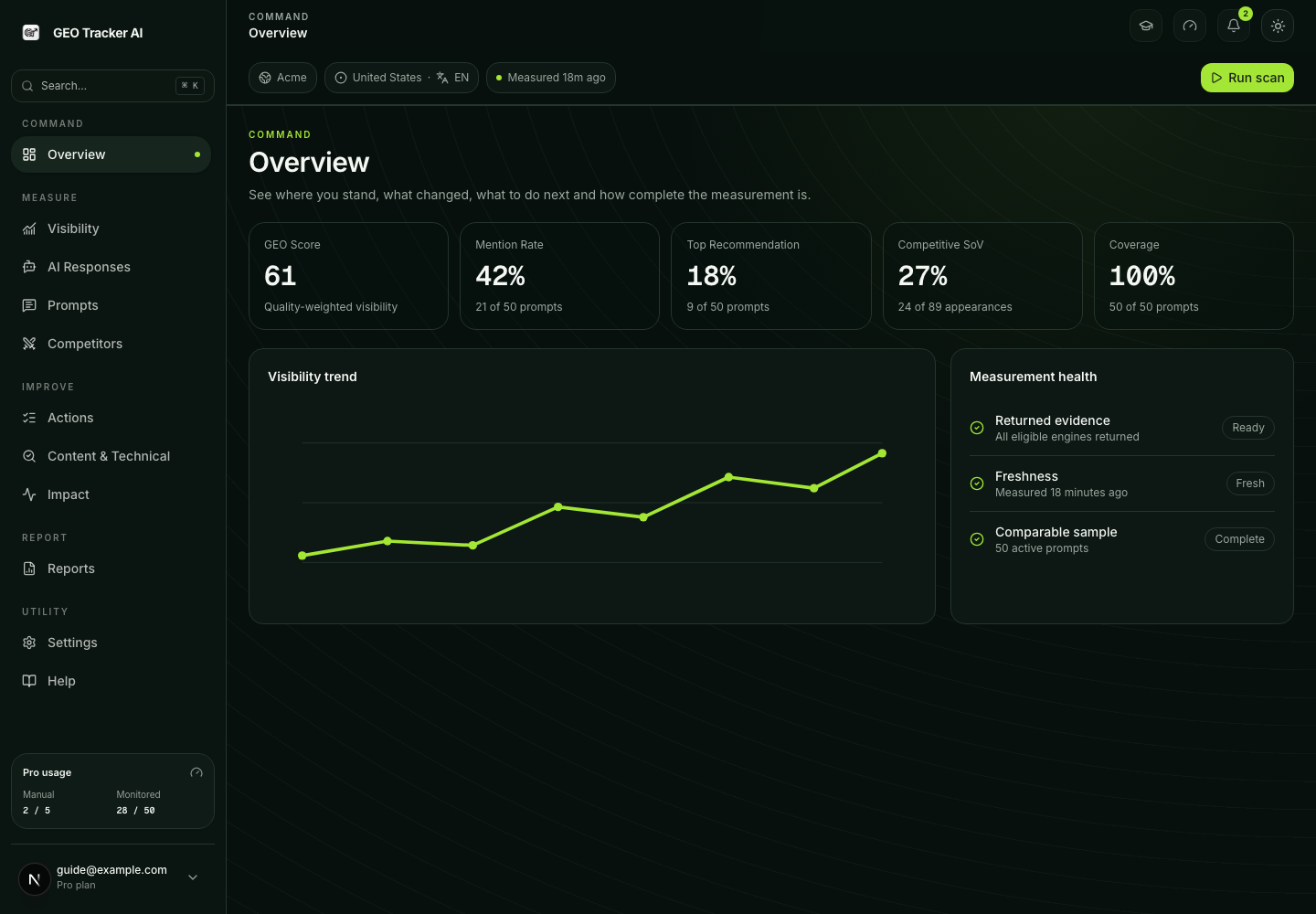
The formula
For each engine we compute an effective rate that blends Mention Rate with mention quality:
mentionRate    = mentioned / total
avgQuality     = qualitySum / mentioned          (0..1, see scale below)
effectiveRate  = mentionRate × (BASELINE + (1 − BASELINE) × avgQuality)
BASELINE is fixed at 0.4. The intuition: even being mentioned with
zero qualitative endorsement is worth 40% of full credit — being noticed at
all matters. The remaining 60% is a quality lift driven by how the AI
framed you (positive recommendation, top-list position, dedicated section).
Each scan_result also carries a confidence weight before it enters the average: a prompt we have verified is worth its full weight, one still "worth tracking" is worth 0.7, and one we have judged off-target is worth 0.3. A prompt we have not classified yet is neutral at 1.0.
We then take a weighted average across engines that returned at least one result for the query batch:
GEO Score = round( Σ (effectiveRate × engineWeight) / Σ engineWeight × 100 )
Engine weights
Your plan measures up to five engines (Perplexity, ChatGPT, Google AI Mode, Gemini, and Google AI Overview — see AI engines). Each is weighted by how much it drives AI-led buyer discovery today:
0.35
ChatGPT
Largest AI-search audience
0.25
Google AI Mode
1.5B reach / month
0.15
Gemini
Google's flagship model
0.15
Perplexity
Citation-rich answers
0.10
Google AI Overview
Above classic results
Weights are calibrated to Q2 2026 data on AI-search reach and share of buyer-discovery traffic. Engines that don't return any results for the query (e.g. Google AI Overview for a query Google doesn't render an overview panel for) drop out of the denominator — they aren't penalised, they're just absent, and the remaining weights renormalise.
For the longer story on why we landed on these numbers, see Methodology → engine weights.
The mention quality scale
Per scan_result we classify the mention into one of four buckets and assign a quality value normalised to 0–1:
| Bucket | Quality | What it means |
|---|---|---|
not_mentioned | 0.00 | Brand not present in the answer at all. |
mentioned | 0.40 | Named once, neutrally — included in a list, mentioned in passing. |
recommended | 0.70 | Framed positively or singled out as a candidate option. |
top_recommended | 1.00 | Top-of-list, explicit "best for X", dedicated paragraph. |
The top bucket moved from 0.90 to 1.00 on 19 July 2026 — at 0.90 the GEO Score could not mathematically exceed 94. See Methodology → AI citation quality buckets for what happened to scores on that date.
A worked example
Imagine you're a deployment platform competing with Vercel and Netlify (this is the running test domain in these docs). To keep the arithmetic readable we'll walk through just three of the engines on a Pro scan (ChatGPT, Perplexity, and Google AI Mode) across 4 buyer questions — Gemini (and, on Business/Scale, Google AI Overview) fold into the same weighted average exactly the same way.
- ChatGPT mentioned you in 3 / 4 questions, average quality 0.70.
- Perplexity mentioned you in 2 / 4 questions, average quality 0.40.
- Google AI Mode mentioned you in 4 / 4 questions, average quality 0.40.
ChatGPT          mentionRate = 0.75   effective = 0.75 × (0.4 + 0.6 × 0.70) = 0.615
Perplexity       mentionRate = 0.50   effective = 0.50 × (0.4 + 0.6 × 0.40) = 0.320
Google AI Mode   mentionRate = 1.00   effective = 1.00 × (0.4 + 0.6 × 0.40) = 0.640

These three engines responded, so their weights (0.35, 0.15, 0.25) renormalise
to sum to 1: ChatGPT 0.467, Perplexity 0.200, Google AI Mode 0.333.

Weighted        (0.615 × 0.467 + 0.320 × 0.200 + 0.640 × 0.333) = 0.5643
GEO Score        round(0.5643 × 100) = 56
So a 56 — you're surfacing reliably on Google AI Mode, doing well on ChatGPT but with mixed framing, and lagging on Perplexity. The score moves when any of those three pieces does.
Why the math is shaped this way
Common questions
Does the score punish me for niche queries that get few results? No — see the third bullet above. If most of the engines on your plan didn't render an answer at all, the score uses just the ones that did.
Why isn't the score higher when I'm mentioned in every engine? Mention quality matters. Being listed as "option 4 of 7" in a roundup counts, but won't move the needle the way "the best for X" does. Use the Citation search to read the actual sentences AI used about you.
Can I see the per-engine breakdown?
Yes — every dashboard snapshot exposes per-engine rate, total,
mentioned, and the engine's contribution weight to the combined score.