Impact and Actions — from evidence to measured outcomes
How Impact, Competitors and Prompts explain outcomes, competition and demand — and how Actions turns evidence into measurable work.
GEO Tracker separates understanding from execution:
- Impact explains observed outcomes and the relationship between AI visibility and read-only Search Console evidence.
- Competitors separates validated product rivals from citation-only sources and shows eligible competitive history.
- Prompts contains Query Intelligence and the live demand evidence available for the tracked prompt set.
- Actions is the working board where recommendations and your own tasks move from To Do to Done.
They use the same underlying scans, citations, competitors, page audits, and integrations, but they answer different questions: what is happening? and what will we do next?
Where the evidence lives
| Workspace | What it answers |
|---|---|
| Impact → Outcome Loop | What changed in the fixed observation window after eligible work was completed? |
| Impact → AI Referral Truth | Starter+ compares AI Visibility with total organic GSC demand and finds tracked-prompt gaps; Business and Scale additionally expose evaluated alert history. |
| Competitors | Which validated product competitors appear, where they win, and — on eligible plans — how backlink authority compares. |
| Prompts | What query-level confidence, citation and supported demand evidence exists around the tracked prompt set. |
Actions is a Kanban board
/dashboard/actions groups the unified action stream into four columns:
- To Do
- In Progress
- Snoozed
- Done
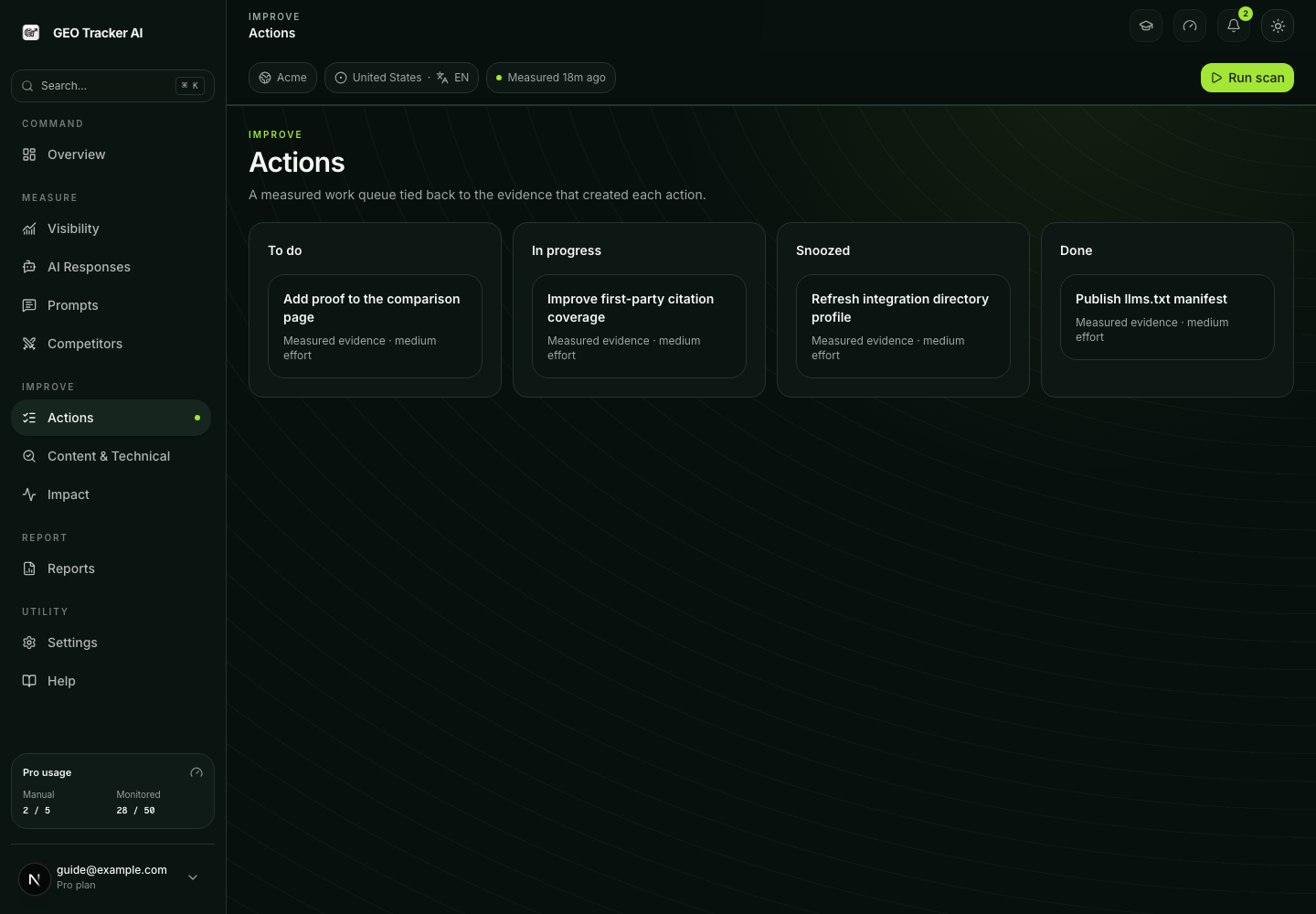
You can filter by source/type/prompt, create a manual action, move cards by drag and drop on desktop, or use explicit move controls on mobile and keyboard-oriented paths. Snoozed work returns after its reminder window. The board keeps generated and manual work in one place rather than scattering separate task lists across the dashboard.
Where actions come from
Action kinds are generated from evidence such as:
- repeated absence or a visibility/competitor gap;
- a crawlability, metadata, structured-data, or content-audit problem;
- a citation source you can approach with a comment, pitch, or pull request;
- an off-target prompt or an untracked query opportunity;
- a manual task you add yourself.
Every generated card should preserve enough provenance to explain why it exists: the originating prompt, scan, page, source, competitor, or signal. A card without a data trail is a generic checklist item, not a GEO recommendation.
Citation Source Intelligence can produce draft material for supported venues. Other action kinds may provide a fix snippet or an exact next step without writing the final editorial copy. No action auto-posts or edits your website.
Marking work done and the Outcome Loop
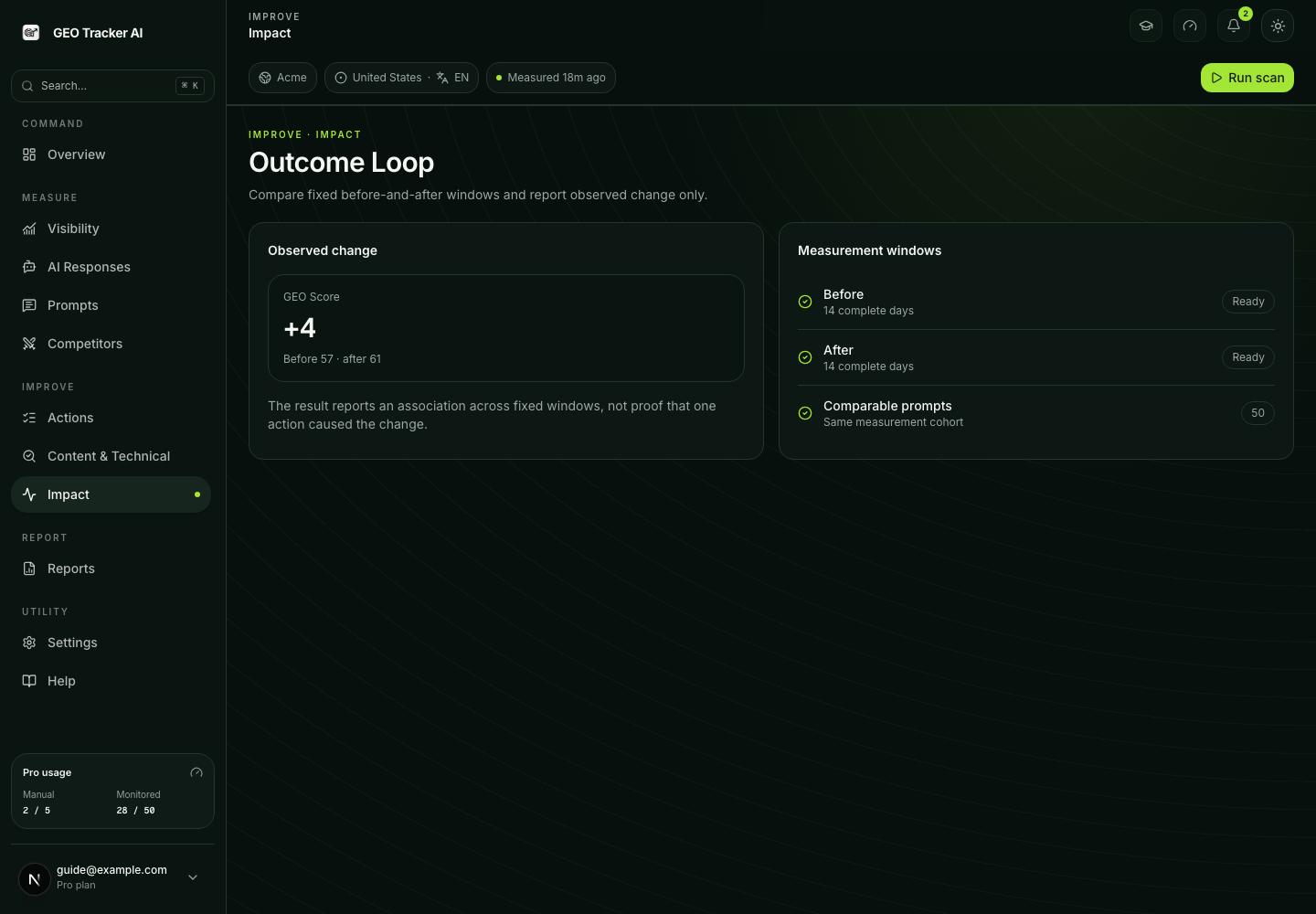
Moving an eligible action to Done records the completion moment and schedules an outcome window. After enough post-action measurement exists, Outcome Loop compares the relevant before/after visibility evidence and reports one of three honest classes:
- measured lift or decline;
- no measurable change;
- not enough comparable data yet.
The normal evaluation window is 14 days. Attribution remains an observed association, not proof that the action was the sole cause; market, engine, prompt, and scan coverage still matter.
When data refreshes
- Scan-derived signals update after manual, pulse, or deep results are finalized.
- Competitor and trend panels use their documented rolling/snapshot windows.
- Search Console evidence depends on a valid connection and completed nightly sync. It is association, not referral attribution; see Google Search Console and AI Referral Truth.
- Outcome evaluation waits for the post-action window and sufficient scans.
- Coming-soon cards do not collect live feature data unless their implementation and flag are enabled.
Honest limits
Read further
- GEO Score — how the headline measurement is built.
- Competitor tracking — how competitor evidence enters Competitors.
- Citation Source Intelligence — supported source-specific drafts and outcomes.
- Content audit — page-level structural evidence.
- Google Search Console — exact sync window, tier gates, correlation contract, query gaps, alerts and limits.